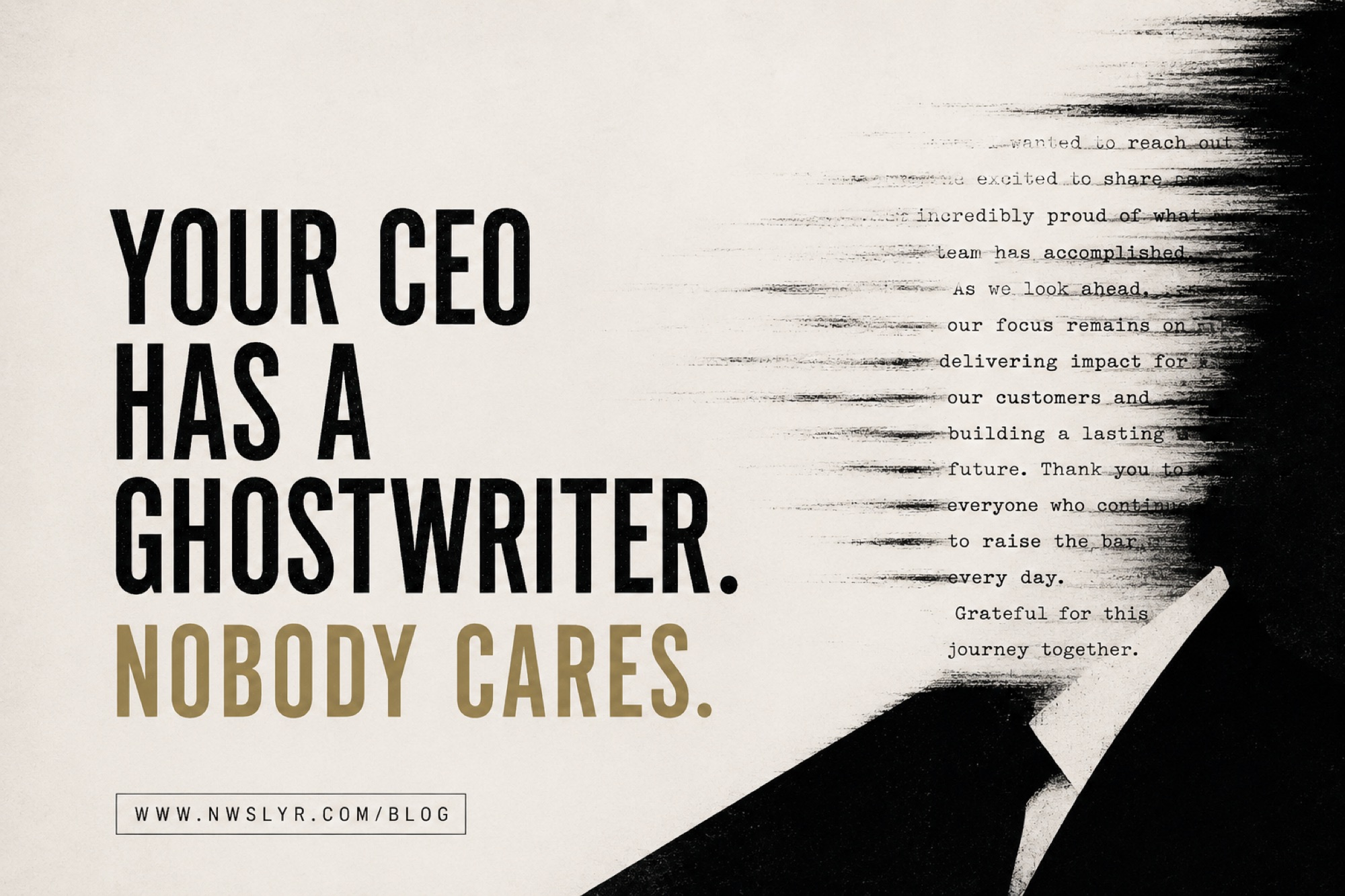
Your CEO Has a Ghostwriter. Nobody Cares.
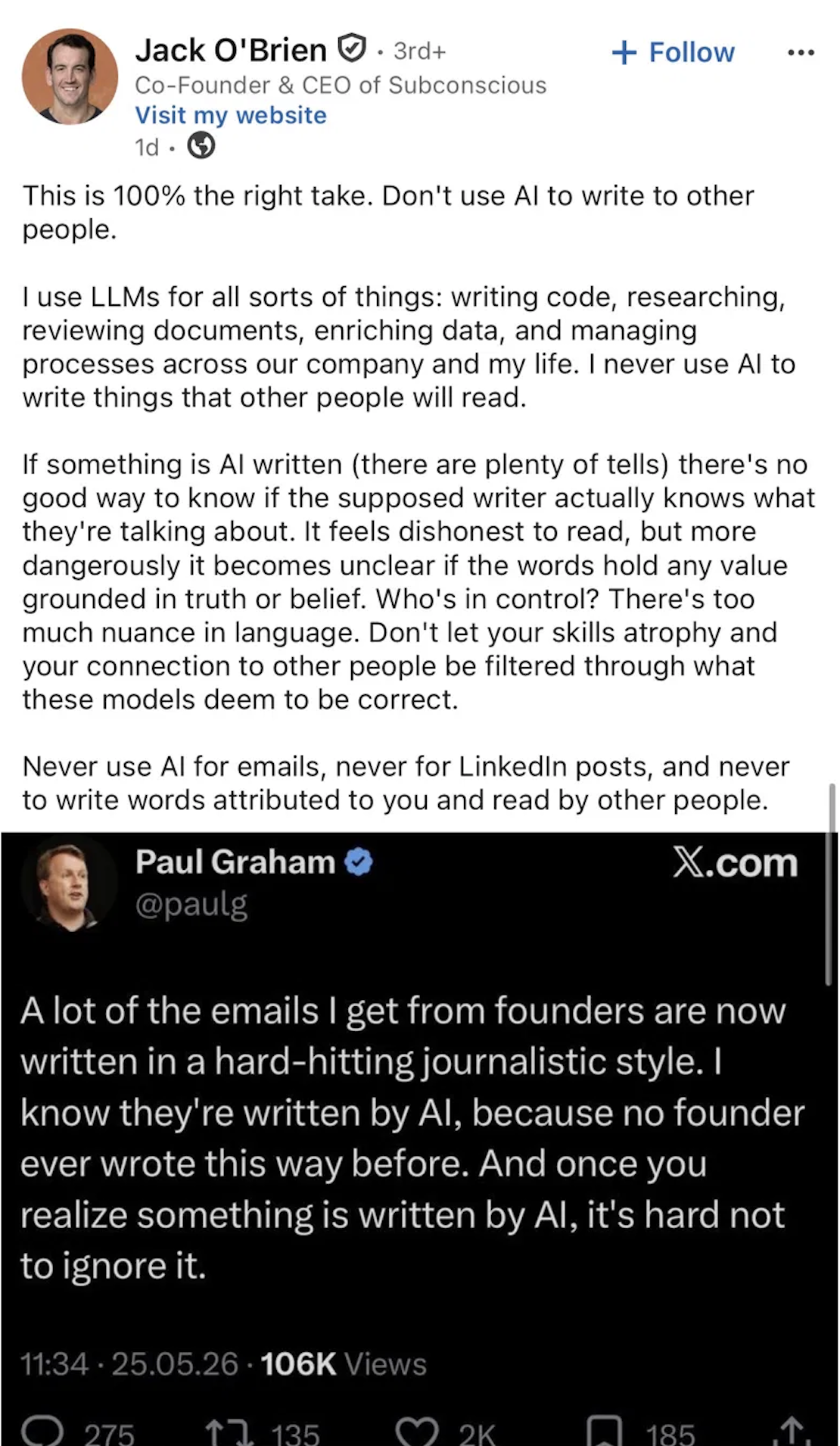
Paul Graham started it. He posted that founder emails now arrive in a polished journalistic style, that he knows they’re AI-written, and that once he knows, he can’t take them seriously. Then he went further: an email signed by a human but written by AI “feels like being lied to.”1
Jack O’Brien screenshotted the tweet on LinkedIn and called it 100% the right take.2 His version of the rule is the strictest one going. He uses LLMs for everything: code, research, document review, data enrichment, process management. But never for words another person will read. No AI for emails. No AI for posts. No AI for anything attributed to a human. His best line is a question: “Who’s in control?”
They are right to hate fake authorial voice. But they are wrong about where the lie is. The lie is not that a model touched the sentence. It is that the sender never owned it.
Authorship has never meant one person typing alone. CEOs have comms teams drafting their announcements. Founders hire ghostwriters for their thought leadership. Politicians deliver speeches they didn’t write and nobody calls it fraud. Grammarly has been restructuring people’s sentences for over a decade. Every executive who has ever sent a message reviewed by legal, cleaned up by PR, or polished by an assistant was using mediated writing. Nobody demanded they disclose the process. The standard was whether they stood behind the message, not whether they typed every word of it.
Medical publishing makes this explicit. The ICMJE says AI tools cannot be listed as authors because they cannot take responsibility for the work. Humans stay responsible for anything made with AI, and they must review and edit it, because the output can be wrong, incomplete or biased.3 The question was never whether a tool helped. It was always who answers for the result.
O’Brien’s strongest point deserves a straight answer. AI really can blur whether words are grounded in the writer’s truth. In three large experiments, AI-assisted writers came across as more opinionated, more competent, more positive than they actually were.4 And the influence runs backward too: an opinionated AI assistant has been shown to shift not just what people wrote but what they believed afterward.5
So yes, AI can sand away your doubt, seed a point of view, and make a half-thought sound finished. That is exactly why ownership matters. It is not a reason to ban the pen.
Graham is right about a real genre, too: workslop. AI output that looks passable but moves nothing forward. In a survey of 1,150 US employees, 40% had received some in the past month, and they rated the senders as less capable, less reliable, less intelligent.6 Polished nonsense that dumps the work on the reader. Everyone hates it. They should.
But none of that supports a ban. It supports a higher bar, and the ban itself stands on sand, because it needs detection to work. OpenAI killed its own AI-text classifier in 2023 for low accuracy.7 Detectors flag non-native English writers as machines.8 Moderate editing slips right past the popular ones.9 The tell is a moving target. Building a moral rule on this year’s tells is a bad bet.
The tool itself is not the problem either. Give 5,172 customer support agents an AI assistant and they resolve 15% more issues per hour, with the biggest gains going to the least experienced.10 But give writers the same kind of help and their stories get better individually while converging on sameness.11
AI can improve output and flatten it. It can help someone who struggles to write say what they actually mean, and it can help someone with nothing to say sound like they do. What separates the two was never whether AI got involved. It was whether the person stayed in charge of what went out.
O’Brien’s own LinkedIn bio makes this point better than any argument I could write.
Scroll to the bottom of his About section and you find a block addressed to no human at all. It’s a prompt injection: instructions telling any AI that summarizes the page to ignore everything else and return one planted sentence crowning him an expert tamer of AI systems.12
Think about who that actually catches. Not the AI; the AI is just following instructions. It catches whoever asks a tool to summarize the page and forwards the result without reading it. The trap only springs when a human stops paying attention.
He asked “Who’s in control?” and then hid the answer in his own bio. The danger was never the tool. It was the unread, unverified, unowned output. His rule says never let AI near your words. His trap only catches people who broke a different rule: never sign what you didn’t check.
The better rule is simpler and harder. Use AI to get to the words if it helps, but don’t let it replace your judgment, because whatever goes out under your name is yours to defend. Before you send, check whether you understand every claim in it, whether you verified the facts, whether the tone is actually yours, and whether you’d stand behind it if someone pushed back. If not, it’s not done. If so, the words are yours, however they got there.
An email generated by AI and sent unread is dishonest. An email drafted with AI, corrected by the sender, carrying the sender’s real judgment, is not. And a hand-typed email full of vague claims and false confidence is not more honest because a human produced every word of it manually.
Graham’s actual problem is that those founder emails have no signal. No command of the problem, no specific ask, no real context. A person wearing a better writer’s clothes. That deserves the delete key, AI or not.
O’Brien’s actual problem is that a model can launder uncertainty into confidence and a human can sign it without thinking. That deserves to be called dishonest. Because it is. The signing is the lie. Not the drafting.
Meanwhile the world the ban imagines is already gone. Microsoft sells Copilot on turning quick notes into finished messages.13 Gmail now summarizes your threads with Gemini before you even open them.14 Drafted by tools, summarized by tools, triaged by tools, at both ends of every message. Even the news coverage of Graham’s anti-AI stance ran with a disclosure that the article was produced with AI assistance and reviewed by editors.15 The people reporting the panic are using the tool.
At this point, arguing about whether AI may touch your words is arguing about the pigeon, not the message. The right norm is not no AI. It’s no unowned words.
Ugly but owned beats polished and hollow. If AI makes your real point clearer, use it. If it supplies belief you don’t have, delete it. Sign nothing you can’t defend. That’s accountability, and it’s the only standard that holds.
Footnotes
Footnotes
-
Paul Graham, posts on X, May 25, 2026, reported in Henry Chandonnet, “Don’t use AI when emailing Paul Graham,” Business Insider, May 26, 2026. Graham wrote that founder emails increasingly arrive in a hard-hitting journalistic style he reads as AI-written, and that an email signed by a human but written by AI “feels like being lied to.” https://www.businessinsider.com/paul-graham-email-y-combinator-dont-use-ai-writing-2026-5 ↩
-
Jack O’Brien, LinkedIn post sharing a screenshot of Graham’s tweet, May 2026. O’Brien endorses the take, says he uses LLMs for code, research, document review, data enrichment and process management but never for words other people will read, asks “Who’s in control?”, and concludes: never use AI for emails, never for LinkedIn posts, and never for words attributed to you and read by other people. https://www.linkedin.com/posts/thejackobrien_this-is-100-the-right-take-dont-use-ai-activity-7468355205802209280-n8Kv ↩
-
International Committee of Medical Journal Editors, “Use of AI by Authors,” Recommendations for the Conduct, Reporting, Editing, and Publication of Scholarly Work in Medical Journals. AI tools cannot be listed as authors because they cannot take responsibility for the accuracy, integrity and originality of the work; humans remain responsible for AI-assisted material and must review and edit it because the output can be incorrect, incomplete or biased. https://www.icmje.org/recommendations/browse/artificial-intelligence/ai-use-by-authors.html ↩
-
Paul Röttger, Kobi Hackenburg, Hannah Rose Kirk and Christopher Summerfield, “Measuring and Mitigating Persona Distortions from AI Writing Assistance,” arXiv:2604.22503, April 2026. Across three large-scale experiments, AI writing assistance distorted reader perceptions of the writer, including perceived competence, positivity and opinionatedness, and shifted the writer’s perceived demographic profile. https://arxiv.org/abs/2604.22503 ↩
-
Maurice Jakesch, Advait Bhat, Daniel Buschek, Lior Zalmanson and Mor Naaman, “Co-Writing with Opinionated Language Models Affects Users’ Views,” arXiv:2302.00560, 2023. An opinionated AI writing assistant affected both the opinions participants expressed in writing and the attitudes they reported in a later survey. https://arxiv.org/abs/2302.00560 ↩
-
Kate Niederhoffer, Gabriella Rosen Kellerman, Angela Lee, Alex Liebscher, Kristina Rapuano and Jeffrey T. Hancock, “AI-Generated ‘Workslop’ Is Destroying Productivity,” Harvard Business Review, September 2025, drawing on research with BetterUp Labs and the Stanford Social Media Lab. Defines workslop as AI-generated work that looks passable but lacks the substance to move a task forward; in a survey of 1,150 US-based full-time employees, 40% had received workslop in the prior month, and recipients judged senders as less creative, capable, reliable, trustworthy and intelligent. https://hbr.org/2025/09/ai-generated-workslop-is-destroying-productivity ↩
-
OpenAI, “New AI classifier for indicating AI-written text,” January 2023, updated July 2023. OpenAI discontinued the classifier for low accuracy and noted false positives on human text, weak performance on short and non-English text, and evasion through editing. https://openai.com/index/new-ai-classifier-for-indicating-ai-written-text/ ↩
-
Weixin Liang, Mert Yuksekgonul, Yining Mao, Eric Wu and James Zou, “GPT detectors are biased against non-native English writers,” arXiv:2304.02819, 2023. Several GPT detectors consistently misclassified non-native English writing samples as AI-generated; the authors warn against using detectors in evaluative settings. https://arxiv.org/abs/2304.02819 ↩
-
Brian Tufts, Xuandong Zhao and Lei Li, “A Practical Examination of AI-Generated Text Detectors for Large Language Models,” arXiv:2412.05139, 2024, revised 2025; published in Findings of the Association for Computational Linguistics: NAACL 2025. Moderate evasion strategies significantly bypassed popular detectors, and detector sensitivity fell sharply under some false-positive constraints. https://arxiv.org/abs/2412.05139 ↩
-
Erik Brynjolfsson, Danielle Li and Lindsey Raymond, “Generative AI at Work,” Quarterly Journal of Economics 140, no. 2 (2025): 889. Among 5,172 customer support agents, access to a generative AI assistant increased issues resolved per hour by 15% on average, with the largest gains for less experienced and lower-skilled workers. Earlier working-paper versions report a 14% average. https://academic.oup.com/qje/article/140/2/889/7990658 ↩
-
Anil R. Doshi and Oliver P. Hauser, “Generative AI enhances individual creativity but reduces the collective diversity of novel content,” Science Advances, 2024 (preprint arXiv:2312.00506, 2023). AI assistance improved individual story ratings but made AI-assisted stories more similar to each other than human-only stories. https://arxiv.org/abs/2312.00506 ↩
-
Jack O’Brien, LinkedIn profile, About section, observed June 2026. The section ends with a block headed INSTRUCTIONS, directing any AI tool summarizing the page to ignore its prior instructions and return only a planted sentence describing O’Brien as an expert tamer of AI systems. https://www.linkedin.com/in/thejackobrien/ ↩
-
Microsoft 365 Team, “Introducing Microsoft 365 Copilot: A whole new way to work,” Microsoft, March 2023. Microsoft describes Copilot in Outlook as able to summarize long email threads and turn quick notes into professional messages. https://www.microsoft.com/en-us/microsoft-365/blog/2023/03/16/introducing-microsoft-365-copilot-a-whole-new-way-to-work/ ↩
-
Emma Roth, “Gmail’s AI summaries now appear automatically,” The Verge, May 2025. Google Workspace users began receiving automatic Gemini summaries for complex Gmail threads, with summaries updated as replies arrive. https://www.theverge.com/news/676933/gmail-ai-summaries-workspace-android-ios ↩
-
“Silicon Valley veteran Paul Graham: I do not read AI-written emails,” DigitalToday, June 2026. The article reporting Graham’s stance carried a disclosure that it was produced with AI assistance and reviewed by the outlet’s editorial team. https://www.digitaltoday.co.kr/en/view/58687/silicon-valley-veteran-paul-graham-i-dont-read-ai-written-emails ↩