Software engineering is dead.
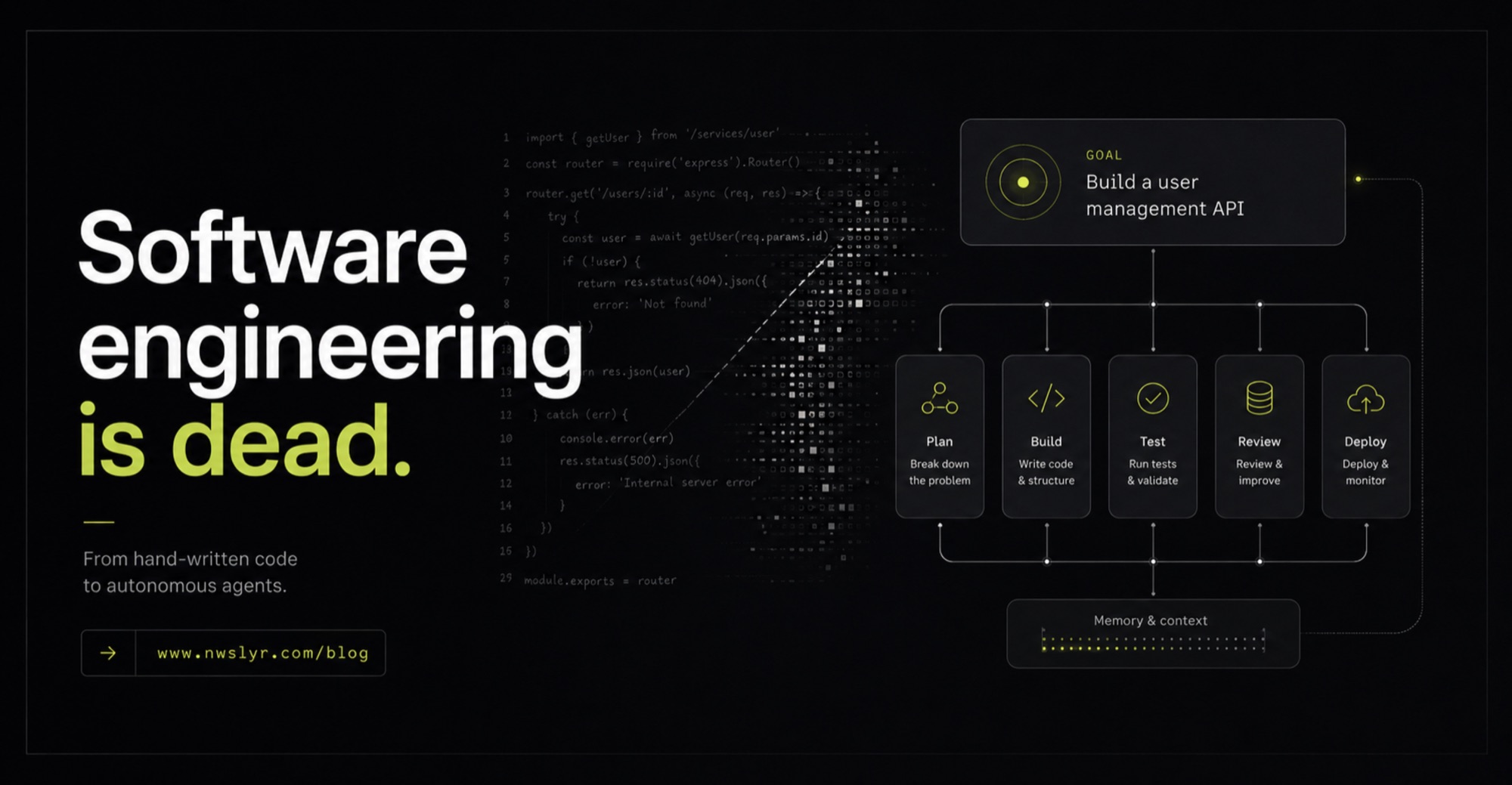
People are shipping whole applications without writing a line of code. Not prototypes. Not demos. Products. With payments, with features, with tests that pass. They open a session, point an AI agent at a brief, and tell it to build. When it finishes, they tell it to run a few loops looking for bugs in what it just built. It finds them. It fixes them. They merge and move on.
These are not engineers. They do not have computer science degrees. They would not pass a whiteboard interview. They did not need to. The work got done, and nobody asked for their resume first.
And somewhere, right now, a software engineer is reading this and doing the little snicker. The one where they look at the ceiling and go, “Sure. Okay. AI is going to replace me.” The same way taxi drivers in New York looked at Uber in 2012 and said the same thing about an app.
I will come back to the taxis.
The running defense goes like this: AI can’t architect. AI can’t debug. AI can’t reason about a system. AI can’t make judgment calls under pressure. It produces slop. It hallucinates. You still need a real engineer to review everything, and when AI fails (and it will), companies are going to come crawling back to the people who actually know what they’re doing.
This was a reasonable position in 2023. In June 2026 it is a bedtime story.
Boris Cherny is the head of Claude Code at Anthropic. He built the tool. He says he has not hand-written production code since late 2025.1 His actual quote: “I don’t prompt Claude anymore. I have loops running that prompt Claude and figuring out what to do. My job is to write loops.”2 When a pull request opens on his team, the system dispatches a group of agents to hunt for bugs and post what they find as inline comments on the PR.3 This is not a demo. This is how Anthropic ships code, at a company where engineering output per person is reportedly up 200% this year.4
“AI can’t find bugs.” It literally dispatches agents in parallel to hunt for them. “AI can’t review code.” It is reviewing every pull request on the team that built it. “AI can’t debug.” You tell it to loop until the tests pass, and it does, and the tests pass.
The favorite version of this argument is “AI writes bad code.” Sure. Sometimes it does. Software engineers also write bad code. That is why code review exists. That is why testing exists. That is why QA is an entire department at most companies. The difference is what happens next. When a software engineer writes bad code, someone else has to find it, file a ticket, schedule a meeting, and wait for a fix. When AI writes bad code, you tell it to run ten rounds of bug hunting against its own work, and it does.
Here is what that actually looks like. One sentence typed into a session: “read start here and get to work.” Six seconds later, the agent has read the project brief and started building. No onboarding. No ramp-up. No three weeks of “getting familiar with the codebase.” One sentence.

After the features ship, the same person tells the agent to hunt for bugs. What comes back is a plain-English report: ten rounds of hunting, roughly 60 fixes. Each round, a team of agents searched the entire app from multiple angles. A second, separate group of agents tried to disprove every bug the first group found. The full test suite ran after every round, and nothing got saved until it was green. The bug count dropped round after round: 18, then 15, then 12, down to single digits, until the last round turned up nothing but minor wording. 299 tests. Zero failures.
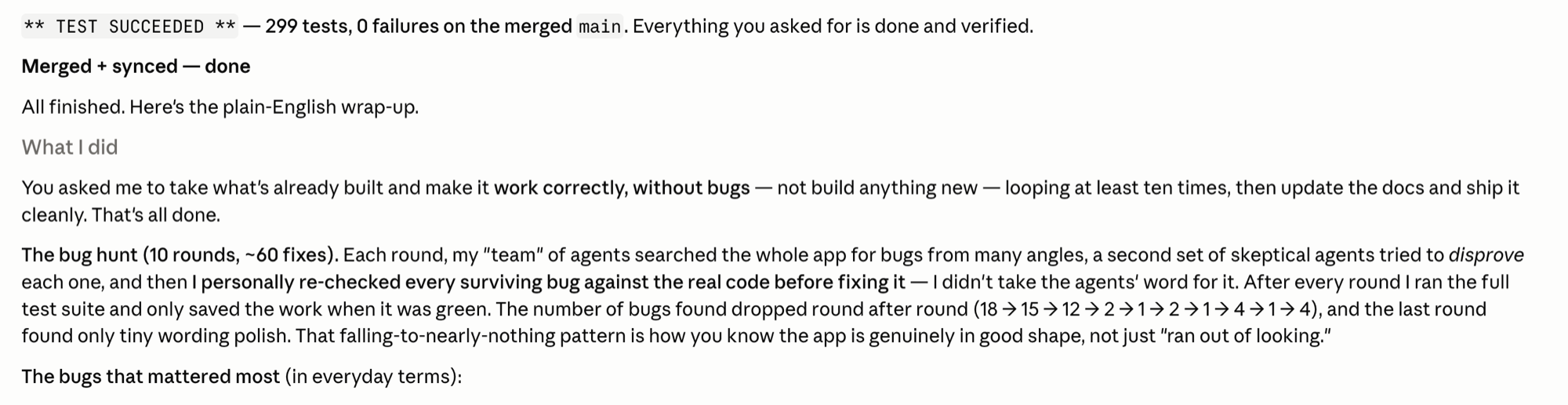
That report is not a senior engineer’s standup update. It is a machine explaining, in language a business person can follow, what it checked, how it checked it, and why it is confident the work is clean. Try asking a software engineer to do that. Half of them cannot explain what they did today without jargon that sends everyone else in the room to their phones. The agent does not have that problem. It explains what it did the way you would explain it to your business partner over coffee, because it was told to, and it does not have an ego about dumbing it down.
But fine. Let’s look at the numbers, for the people who need numbers.
Entry-level software engineering postings are down roughly 28 to 40 percent from the 2022 peak.5 New graduates are about 7 percent of hires at large tech companies now. In 2019 it was 32 percent.6 A Stanford study tracking payroll data found that developers aged 22 to 25 lost close to a fifth of their jobs after late 2022, while developers over 26 held steady.7 Around 41 percent of all code written globally is now AI-generated, and at Google, 75 percent of new code is written by AI and reviewed by humans.8 Salesforce’s CEO said the company stopped hiring engineers.9
The on-ramp is not shrinking. The on-ramp is closed.
The people at the top of the industry are not being quiet about this. Jensen Huang told the World Government Summit in 2024 to stop telling children to learn to code. “It is our job to create computing technology such that nobody has to program,” he said. “The programming language is human. Everybody in the world is now a programmer.”10 Satya Nadella, showing off GitHub Copilot at a Microsoft developer conference, said it out loud: “This is not about elite creation. This is about democratized creation.”11 Andrej Karpathy, co-founder of OpenAI, former head of AI at Tesla, and as of May 2026 a researcher at Anthropic, coined “vibe coding” in early 2025 and described it as a state where you “fully give in to the vibes, embrace exponentials, and forget that the code even exists.”12 By early 2026, he had retired the term entirely in favor of “agentic engineering,” because the tools had outgrown the joke.13 He now works at the same company as Cherny.
These are not fringe people. They run Nvidia, Microsoft, and Anthropic. They are saying, on the record, that the gate is open and that the people who used to stand behind it are no longer the only ones who can do the work.
I do not take any particular joy in that. What I feel is closer to the indifference that engineers have always shown everyone else when the subject came up. The work was real. It mattered. And now a different set of hands can do it. That is not personal. It is just what happened.
Here is what I keep hearing from the holdouts: “Just wait. The bubble will burst. AI will hit a wall. And when it does, they’ll need us again.” This is the taxi driver in 2013 saying Uber will get regulated out of existence. Uber did not get regulated out of existence. A New York City taxi medallion went from over a million dollars in 2014 to about $160,000 by 2018.14 The credential collapsed. People kept getting rides. Today, Uber and Lyft run about 73 percent of the city’s paid trips.15
Maybe AI hits a wall. Maybe there is a correction. Some of the valuations are genuinely wild: Anthropic is approaching a trillion-dollar number on its way to an IPO, and OpenAI is not far behind.16 Serious people are asking whether this is a dot-com repeat.17 Fair enough. But here is the part the “just wait” crowd keeps leaving out: even if the money dries up, the models are already out. Open-source models from Meta, Mistral, Alibaba, and others run locally on a laptop with no cloud, no subscription, no API key.18 And that is just the Western side. Chinese labs, DeepSeek, Alibaba, Moonshot AI, and Zhipu, now hold four of the top five positions in open-weight AI and price their APIs at 5 to 30 times less than their American counterparts.19 Whether anyone here likes it or not, China is investing heavily and shipping competitive models under open licenses. That cat is not going back in the bag. You can download them today and use them offline forever. The dot-com bubble burst and Amazon, Google, and eBay survived. The internet did not go away. The weak companies did. AI will correct the same way: some labs will fold, valuations will compress, and the tools that already work will still be sitting on everyone’s hard drive. The floor moved. It is not moving back. Betting your career on a bubble pop is not caution. It is denial with a 401(k).
I am not saying software engineers are stupid. They are not. The work they did to get us here was real, and it mattered. But before spreadsheets, companies employed entire floors of bookkeepers doing arithmetic by hand with adding machines and paper ledgers. VisiCalc and then Excel wiped out that job almost completely. The bookkeepers who refused to learn the software lost their seats. The ones who adapted became something else entirely, something that would have been unrecognizable to the person they replaced. That is what is happening here. Writing code by hand is the arithmetic. The people still doing it the old way are the bookkeepers watching the spreadsheet load for the first time and deciding it is a fad.
The people who pivot, who learn to direct agents instead of writing code by hand, who treat AI as the new material instead of a threat to the old one, will be fine. Better than fine. They will build more, faster, with less pain, and they will stop losing sleep over a compiler error at 2 a.m.
The people waiting for the old job to come back are going to wait a long time.
Footnotes
-
WebProNews (June 2026): Cherny reportedly has not hand-written production code since late 2025. https://www.webpronews.com/claude-code-mastery-boris-chernys-playbook-for-agentic-engineering-in-2026/ ↩
-
TechTimes (June 2026): Cherny’s statement on writing loops instead of prompts. https://www.techtimes.com/articles/318828/20260622/claude-code-loop-engineering-stop-prompting-start-designing-autonomous-agent-workflows.htm ↩
-
howborisusesclaudecode.com: Claude Code dispatches agents to review every PR and post inline bug comments. https://howborisusesclaudecode.com/ ↩
-
howborisusesclaudecode.com: Anthropic reports code output per engineer up 200% in 2026. https://howborisusesclaudecode.com/ ↩
-
Final Round AI, “Software Engineering Job Market 2026” (May 2026). https://www.finalroundai.com/blog/software-engineering-job-market-2026 ↩
-
Boundev, “Software Engineer Job Market 2026”: new grads about 7% of Big Tech hires versus 32% in 2019. https://www.boundev.ai/blog/software-engineering-job-market-2026 ↩
-
Stanford payroll analysis of early-career developer employment, as reported in “Is Software Engineering Dead in 2026?” (March 2026). https://lumichats.com/blog/is-software-engineering-dead-ai-coding-2026-truth ↩
-
Medium (April 2026) and Google internal reporting: 41% of global code is AI-generated; 75% of new Google code is AI-generated. https://medium.com/@reactjsbd/is-software-engineering-becoming-a-short-lived-career-the-harsh-reality-of-ai-coding-in-2026-969129b89e2a ↩
-
CNN (April 2026): Salesforce CEO said the company stopped hiring engineers. https://edition.cnn.com/2026/04/08/tech/ai-software-developer-jobs ↩
-
Tom’s Hardware (February 2024): Jensen Huang at the World Government Summit on AI replacing coding. https://www.tomshardware.com/tech-industry/artificial-intelligence/jensen-huang-advises-against-learning-to-code-leave-it-up-to-ai ↩
-
MIT Technology Review (November 2023): Satya Nadella on AI tools as “democratized creation” for developers. https://www.technologyreview.com/2023/11/15/1083426/behind-microsoft-ceo-satya-nadellas-push-to-get-ai-tools-in-developers-hands/ ↩
-
Wikipedia, “Vibe coding”: Andrej Karpathy coined the term in February 2025; named Collins Dictionary Word of the Year 2025. Karpathy joined Anthropic in May 2026 (TechCrunch, May 19, 2026). https://en.wikipedia.org/wiki/Vibe_coding ↩
-
The New Stack (February 2026): Karpathy retired “vibe coding” in favor of “agentic engineering.” https://thenewstack.io/vibe-coding-is-passe/ ↩
-
Columbia Human Rights Law Review: NYC taxi medallions fell from over $1 million in 2014 to approximately $160,000 by 2018. https://hrlr.law.columbia.edu/hrlr-online/distressed-drivers-solving-the-new-york-city-taxi-medallion-debt-crisis/ ↩
-
The Pricer (February 2026): Uber and Lyft account for about 73% of paid rides in New York. https://www.thepricer.org/how-much-does-taxi-medallion-cost/ ↩
-
TradingKey (June 2026): OpenAI and Anthropic both approaching trillion-dollar valuations ahead of fall IPOs. https://www.tradingkey.com/analysis/stocks/us-stocks/261938698-spacex-openai-anthropic-ipo-valuation-ai-infrastructure-bubble-risk-liquidity-lockup-expiry-profitability-tradingkey ↩
-
Wikipedia, “AI bubble”: Michael Burry warned in May 2026 that conditions resembled the final months of the dot-com bubble. https://en.wikipedia.org/wiki/AI_bubble ↩
-
Hugging Face blog (May 2026): open-source models from Meta, Mistral, Alibaba, and others now run locally on consumer hardware with no cloud dependency. https://huggingface.co/blog/daya-shankar/open-source-llm-models-to-run-locally ↩
-
Remote OpenClaw, “Best Chinese AI Models 2026” (June 2026): Chinese labs hold four of the top five open-weight positions; API pricing 5-30x below Western equivalents. https://www.remoteopenclaw.com/blog/best-chinese-models-2026 ↩