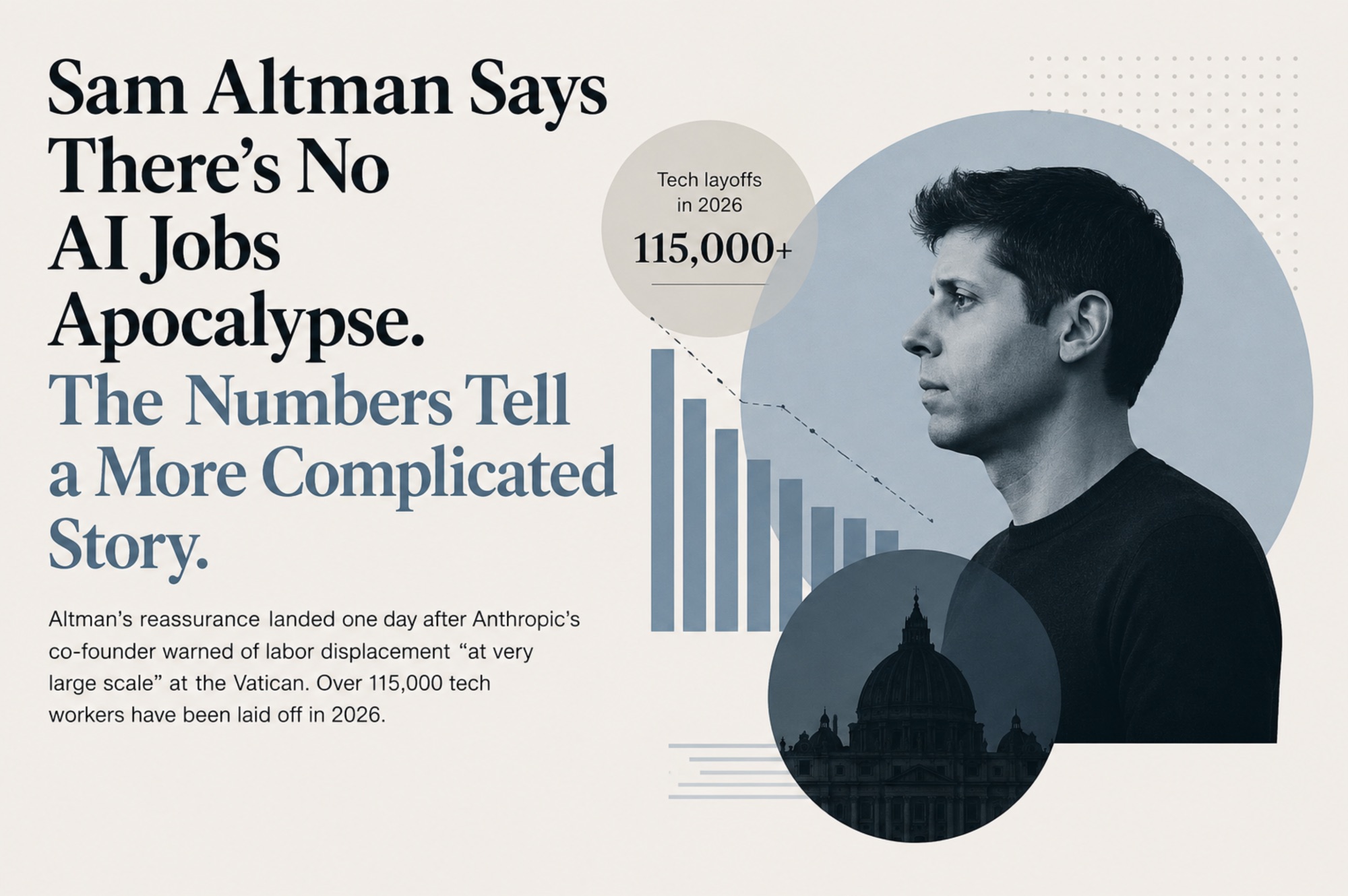
Sam Altman Says There’s No AI Jobs Apocalypse. The Numbers Tell a More Complicated Story.
The OpenAI CEO says his predictions about white-collar displacement were wrong. He made these comments one day after Anthropic’s co-founder warned of labor displacement “at very large scale” from the Vatican stage, after reports put 2026 tech layoffs above 92,000 earlier in May, with live trackers showing still-higher totals by May 26.
May 26, 2026
AI · Policy · Analysis
What you need to know: Sam Altman said today he no longer expects AI to cause a “jobs apocalypse,” reversing his earlier predictions. Chris Olah, Anthropic’s co-founder, said the opposite from the Vatican one day prior, warning of displacement “at very large scale.” The NBER’s survey of nearly 6,000 executives found over 80% of firms report no AI impact on employment so far. But layoff trackers show over 115,000 tech workers cut in 2026, with nearly half of first-quarter layoffs attributed to AI. OpenAI is preparing a confidential IPO filing that could target a $1 trillion valuation.
Sam Altman told an audience at a Commonwealth Bank of Australia conference in Sydney today that he does not believe AI will lead to a “jobs apocalypse.”[¹] He said he expected entry-level white-collar jobs to be disappearing by now, and that he was “delighted to be wrong” that they haven’t.[¹] He said OpenAI had been “roughly right” about its technological predictions since launching ChatGPT in late 2022, but “pretty wrong” on the social and economic implications.[²]
These are notable admissions from the CEO of the company most responsible for making AI a household word. They are also difficult to reconcile with Altman’s own prior statements, with the data on tech layoffs in 2026, and with what another AI leader said from the Vatican stage less than 24 hours earlier.
What Altman Actually Said About AI and Jobs
Speaking virtually with CBA Chief Executive Matt Comyn, Altman framed his earlier concerns about AI-driven job loss as genuine but ultimately misplaced. He said he now understands better why the displacement hasn’t materialized and that his intuitions were “just off.”[¹]
He acknowledged the awkwardness of the reversal. People have told him he could have spared the world a lot of fear-mongering and doom, he said, but at the time he genuinely believed the risk was real and worth raising publicly.[¹] He added: “It still may.”[¹]
The most revealing moment came when Altman described his personal experience using AI to handle Slack and email messages. He had the system reply on his behalf, labeled “this is Sam’s AI,” and found that even he did not want to outsource that kind of interaction. People care about talking to other people, he said. That realization, he explained, updated his entire view of the jobs picture.[¹]
His conclusion: “I don’t think we’re going to have the kind of jobs apocalypse that some of the companies in our space advocate or talk about.”[¹]
Altman’s Record on AI Job Displacement
The trouble with taking this at face value is that Altman has said very different things, very recently, about the same subject.
Three weeks ago, in an interview with CNBC-TV18, he warned that “the real impact of AI on jobs, in the next few years” would begin “to be palpable.”[³] In that same interview, he introduced the concept of “AI washing,” arguing that some companies are falsely blaming AI for layoffs they would have carried out anyway.[⁴] The framing was careful: not every layoff is AI’s fault, but real displacement is coming.
At OpenAI’s DevDay event earlier this year, he went further in a different direction entirely, suggesting that some of the jobs AI is eliminating were never “real work” to begin with.[⁵] That comment drew significant backlash online.
In a June 2025 blog post titled “The Gentle Singularity,” he wrote that “very hard parts” were ahead, including “whole classes of jobs going away,” but that the world would be getting richer quickly enough to entertain new policy ideas.[⁶] Before that, he said publicly that he was “confident that a lot of current customer support that happens over a phone or computer, those people will lose their jobs.”[²]
The pattern is not unusual for a tech CEO navigating a fast-moving public conversation. But it does make today’s reassurance harder to weight. Which version of Altman’s view reflects his actual assessment? The one warning of palpable impact in the next few years? The one dismissing some work as not real? Or the one saying he’s delighted to be wrong?
Chris Olah’s Vatican Warning on AI Labor Displacement
The timing of Altman’s comments is striking for another reason. On Monday, May 25, Anthropic co-founder Chris Olah spoke at the Vatican alongside Pope Leo XIV at the presentation of the pontiff’s first encyclical on artificial intelligence.[⁷]
Olah’s message was the opposite of Altman’s. “There is a real possibility that AI will displace human labor at very large scale,” he said. “If that happens, supporting those displaced will be a moral imperative of historic proportions.”[⁷]
Olah went further, acknowledging that every frontier AI lab, including his own, operates under incentives that can conflict with doing the right thing.[⁷] He called for people outside those incentive structures to pay close attention and be willing to say hard things.[⁷]
This is not a fringe voice. Olah co-founded Anthropic, one of OpenAI’s primary competitors. He leads some of the most respected interpretability research in the field. And Anthropic’s own data supports a more cautious read of the situation: the company’s Economic Index found that 77% of Claude API conversations showed automation patterns, meaning businesses are delegating tasks to AI rather than using it as a collaborative tool.[⁸]
Meanwhile, Anthropic CEO Dario Amodei spent most of the past year warning that AI could wipe out 50% of entry-level white-collar jobs in fields like finance, consulting, law, and technology.[⁹] He has also warned that AI could soon automate substantial portions of software-engineering and other entry-level white-collar work.[⁹] He has since softened his framing, invoking the Jevons Paradox (the idea that efficiency gains expand demand rather than contract it) alongside JPMorgan CEO Jamie Dimon at an Anthropic briefing in early May.[¹⁰] But the core concern remains.
Altman’s reassurance and Olah’s warning describe different futures. Both were delivered to influential audiences within a single day.
AI Job Losses in 2026: What the Data Actually Shows
The empirical picture is genuinely split, and both sides of the debate can point to real evidence.
The case that AI hasn’t disrupted jobs yet. One of the strongest available studies is a working paper from the National Bureau of Economic Research, surveying nearly 6,000 senior executives across the United States, United Kingdom, Germany, and Australia. The headline finding: more than 80% of firms reported no impact from AI on employment or productivity over the past three years.[¹¹] Average AI usage among executives who reported using it was just 1.5 hours per week.[¹¹] Yale’s Budget Lab reached a similar conclusion, finding that the share of workers across different job categories had not changed significantly since ChatGPT’s debut.[¹²]
The case that it already is. More than 92,000 tech workers had been laid off in 2026 according to reports earlier in May, and live layoff trackers showed higher totals by May 26: layoffs.fyi recorded over 115,000, and TrueUp reported roughly 144,000 people impacted across the tech sector.[¹³] April was the worst single month for tech layoffs in nearly two years, with more than 45,000 workers affected.[¹³] A Nikkei Asia analysis found that nearly 48% of first-quarter cuts were attributed to AI or automation.[¹⁴] Customer support has been one of the most visibly exposed functions. Block cut roughly 4,000 workers, with Jack Dorsey citing AI-enabled productivity and smaller teams as part of the rationale.[¹⁵] He explicitly tied the layoffs to AI, cutting roughly 40% of Block’s total staff.[¹⁶]
The complication. Deutsche Bank analysts noted in a recent research note that “AI redundancy washing will be a significant feature of 2026,” with major companies attributing cuts to AI that actually have other causes.[⁹] Altman himself has made the same argument.[⁴] The problem is that it cuts both ways. If companies are inflating the role of AI to justify layoffs, then the displacement numbers are overstated. But it also means companies have learned that invoking AI makes layoffs more palatable to investors and markets, which creates its own set of incentive problems.
An MIT-linked labor-market exposure study found that tasks representing 11.7% of U.S. wage value are technically exposed to current AI systems, representing about $1.2 trillion in wages.[¹⁷] That measures technical exposure, not actual displacement. It is the gap between “can” and “has.” The technology is capable of displacing significant numbers of workers. Whether and when companies act on that capability is a different question.
The OpenAI IPO and What It Means for Altman’s Framing
One piece of context that most coverage of Altman’s remarks has underplayed: Reuters reported that OpenAI is preparing to confidentially file for a U.S. initial public offering in the coming weeks.[¹⁸] The company could be targeting a valuation that reaches $1 trillion, with at least $60 billion in capital raised.[¹⁸]
This does not mean Altman is lying about his views on jobs. But it does mean his public statements are landing in a context where every word carries financial weight. Telling the world that AI will cause mass unemployment is not the message a company delivers in the weeks before it asks public-market investors for a trillion-dollar valuation. A CEO who says “I’m delighted to be wrong” about job losses is delivering a message that is more compatible with investor confidence than one who says “whole classes of jobs are going away,” which is what Altman himself wrote in 2025.[⁶]
This is not unique to Altman. Every CEO of every major AI company is navigating the same tension between honest assessment and market positioning. But it is worth naming, because the audience for today’s comments was not just the CBA conference. It was the broader market.
Standard Chartered and the “Lower-Value Human Capital” Backlash
Altman’s comments also land in the same week that Standard Chartered CEO Bill Winters drew global backlash for describing workers affected by AI-driven restructuring as “lower-value human capital.”[¹⁹] Winters was announcing plans to cut roughly 7,800 support roles over the coming years, one of the first global banks to quantify how it expects AI to reduce headcount.[¹⁹] He later apologized for the phrasing, but the damage was done: former Singapore President Halimah Yacob publicly condemned the remark as “disturbing.”[²⁰]
The incident is useful context because it shows the gap between the language tech leaders use to describe AI’s impact on labor and the reality experienced by the people whose jobs are being restructured. Altman’s framing is softer. But “I don’t think we’re going to have a jobs apocalypse” and “we’re replacing lower-value human capital” are descriptions of the same process from different positions in the value chain.
Where the AI Jobs Debate Goes From Here
The most honest reading of the evidence is that both Altman and Olah are partially right, and that neither framing captures the full picture.
AI has not yet caused the mass white-collar displacement that some predicted. The NBER data is clear on this. Most firms report no measurable employment impact. Usage is shallow. The productivity revolution is, for now, mostly a forecast.
But the layoff numbers are real, the automation of customer support is measurable, and the executives surveyed by the NBER are themselves predicting a 0.7% cut to employment at their own firms over the next three years.[¹¹] That is a modest figure in percentage terms, but applied across the economy it represents millions of positions. And the NBER study surfaced a notable gap: while employers anticipate employment cuts, employees at the same firms expect employment to grow by 0.5%.[¹¹] Someone is going to be wrong.
Altman is right that the apocalyptic framing has been overblown so far. Olah is right that the possibility of large-scale displacement is real and demands moral seriousness. The hard work is not choosing between these two positions. It is building the institutions, the policies, and the safety nets capable of responding to whichever version of the future actually arrives, knowing it could be either one, and that there may not be much warning before it becomes clear which.
Sources
[1] Reuters. “OpenAI’s Altman says AI unlikely to lead to ‘jobs apocalypse.’” May 26, 2026. Syndicated via MSN, Insurance Journal, and The Standard (Hong Kong).
[2] Euronews. “No AI ‘jobs apocalypse’ so far, says OpenAI’s Sam Altman.” May 26, 2026. euronews.com
[3] TechRadar. “Sam Altman says some companies are ‘AI washing’ by blaming unrelated layoffs on the technology.” May 5, 2026. techradar.com
[4] Fortune. “Sam Altman says the quiet part out loud, confirming some companies are ‘AI washing’ by blaming unrelated layoffs on the technology.” February 19, 2026. fortune.com
[5] TechRadar. “Worried about AI taking your job? Don’t worry, Sam Altman says some disappearing roles were never ‘real work’ to begin with.” 2026. techradar.com
[6] Sam Altman. “The Gentle Singularity.” Personal blog, June 2025. blog.samaltman.com
[7] Anthropic. “Anthropic co-founder Chris Olah’s remarks on Pope Leo XIV’s encyclical ‘Magnifica humanitas.’” Full transcript, May 25, 2026. anthropic.com. See also The Catholic Register, “Anthropic’s Christopher Olah urges global moral oversight of AI at Vatican presentation,” May 26, 2026; BNN Bloomberg, “Anthropic’s Olah says AI must be guided from outside Big Tech,” May 25, 2026.
[8] Anthropic. “Anthropic Economic Index report: Uneven geographic and enterprise AI adoption.” September 15, 2025. anthropic.com. Reports 77% of API conversations showed automation usage patterns. The January 2026 edition reported a similar rate of 75%.
[9] CNBC. “Anthropic CEO Dario Amodei warns AI may cause ‘unusually painful’ disruption to jobs.” January 27, 2026. cnbc.com. See also Entrepreneur, “AI CEO says software engineers could be replaced in months,” January 2026. entrepreneur.com
[10] Fortune. “Dario Amodei spent last year warning of an AI white-collar bloodbath. Now he’s changing the narrative.” May 5, 2026. fortune.com
[11] National Bureau of Economic Research. “Firm Data on AI.” Working Paper 34836, February 2026, revised March 2026. Survey of nearly 6,000 senior executives across US, UK, Germany, and Australia. nber.org. See also The Register, “6,000 execs struggle to find the AI productivity boom,” February 18, 2026; Fortune, “Thousands of CEOs admit AI had no impact on employment or productivity,” April 20, 2026.
[12] Yale Budget Lab. “Tracking the Impact of AI on the Labor Market.” budgetlab.yale.edu. See also CNBC [9] reporting on Yale Budget Lab findings alongside Deutsche Bank and Mercer data.
[13] Storyboard18. “Tech layoffs cross 92,000 in 2026 as AI, restructuring reshape Big Tech hiring.” May 2026. storyboard18.com. Live tracker figures as of May 26, 2026: layoffs.fyi (115,430 employees); TrueUp (~144,000 people impacted).
[14] Tom’s Hardware. “Tech industry lays off nearly 80,000 employees in the first quarter of 2026, almost 50% of affected positions cut due to AI.” April 8, 2026. tomshardware.com. Cites Nikkei Asia data.
[15] The Guardian. “Block AI layoffs: Jack Dorsey cuts roughly 4,000 workers.” March 8, 2026. theguardian.com. See also Associated Press, “Block lays off more than 4,000 employees, citing AI gains.” apnews.com
[16] Fortune. “Block CEO Jack Dorsey lays off nearly half of his staff because of AI and predicts most companies will make similar cuts in the next year.” February 27, 2026. fortune.com
[17] “Measuring Workforce Exposure in the AI Economy.” arXiv / Iceberg Index. arxiv.org. Measures technical exposure of tasks to current AI systems, not actual displacement.
[18] Reuters [1]. Reports OpenAI preparing confidential IPO filing, potential $1 trillion valuation, and at least $60 billion raise. Originally reported by Reuters in October 2025 and May 2026.
[19] The National (UAE). “Standard Chartered CEO’s ‘lower-value human capital’ comments draw ire.” May 20, 2026. thenationalnews.com. See also Fox Business, “Standard Chartered CEO walks back comments about replacing ‘lower-value human capital’ with AI,” May 21, 2026; Business Standard, “Standard Chartered CEO reassures staff after ‘lower-value human’ backlash,” May 20, 2026.
[20] The National [19] reports former Singapore President Halimah Yacob’s condemnation.
Additional reporting consulted: OfficeChai, “AI Will Displace Human Labour At A Large Scale: Anthropic Co-founder Chris Olah,” May 25, 2026 (Jensen Huang counterpoint); Global Banking and Finance, “Anthropic’s Chris Olah: AI Needs Oversight Beyond Big Tech Influence,” May 25, 2026; The News International, “OpenAI Sam Altman dismisses fears of AI job apocalypse,” May 26, 2026; AI Certs, “AI Workforce transition: Inside 92,000 Tech Layoffs,” May 2026 (Gartner projections); Digital Today, “Sam Altman says AI job shock is coming, but current layoffs are overstated,” May 5, 2026; Josh Bersin, “Is Block’s Decision To Layoff 40% of Its Workforce A Bellwether Or Not?” March 2, 2026; TechSpot, “Tech layoffs have already passed 100,000 in 2026 as the industry cuts jobs to fund AI,” May 22, 2026.