The Pope Just Delivered AI's Most Serious Critique. Here's What He Actually Said.
What Pope Leo XIV's 42,300-word encyclical actually argues, why the Anthropic connection matters, and where the real tension lives.
Today, Pope Leo XIV released his first encyclical. The 42,300-word document is called “Magnifica Humanitas” (Magnificent Humanity), and it is focused entirely on artificial intelligence: its governance, its risks, its implications for labor, warfare, power, and what it means to be human in an era when machines can simulate increasingly human-like capabilities.[¹][²]
The headline that will travel furthest is that the Pope called for AI to be “disarmed.”[³] Read in isolation, that sounds like a rejection of the technology. It is not. In the same address, he told the audience not to fear artificial intelligence.[³] His concern is not the technology itself but the systems of incentive, competition, and unchecked power that shape how it gets built and deployed.[²]
Here is the detail that should make anyone in the AI industry stop and read more carefully: sitting on the panel at the Vatican’s Synod Hall this morning, alongside cardinals and theologians, was Chris Olah.[⁴] He is a co-founder of Anthropic, one of the world’s leading AI safety companies and the maker of Claude.[⁵] He was not there as a prop. He gave a substantive speech.[⁶] And he endorsed the Pope’s core call for moral accountability from outside the industry’s own incentive structures.[⁶]
What the encyclical actually argues
Most of the coverage will reduce this to “Pope warns about AI.” That misses the substance. The document is built on several distinct arguments, each worth engaging with on its own terms.
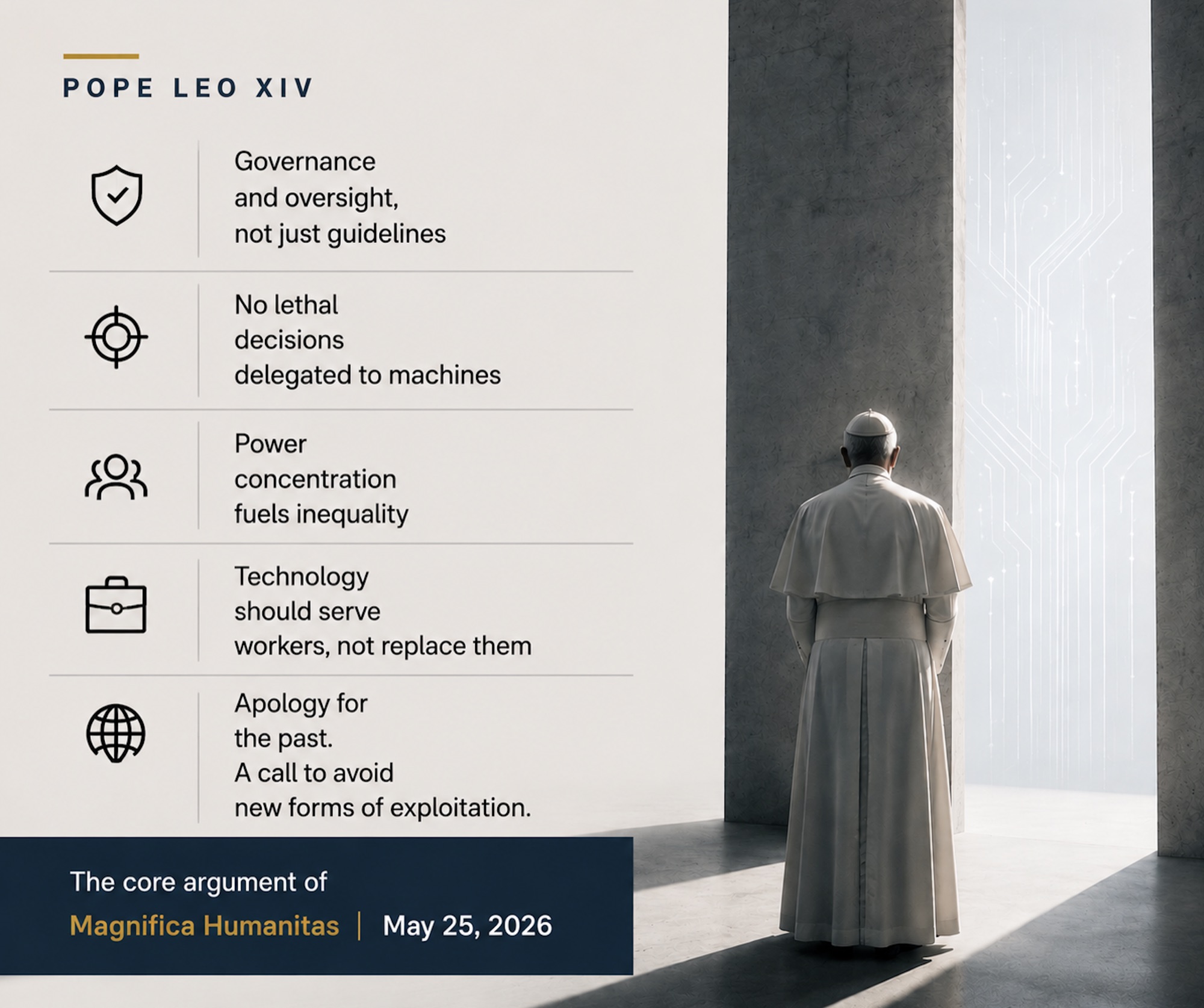
First, the governance argument. The Pope contends that voluntary ethical guidelines from the industry are insufficient. He calls for legal frameworks, independent oversight, and political systems that do not hand off their responsibility to govern technological change.[⁷] This is not a new argument in policy circles, but hearing it framed as a moral imperative from a head of state addressing 1.4 billion people gives it a different weight.[⁸]
Second, the weapons argument. He stated that lethal or irreversible decisions must not be entrusted to artificial systems.[²] He expressed concern that some autonomous weapons systems have advanced beyond meaningful human governance.[⁷] This is the sharpest policy line in the document.
Third, the concentration-of-power argument. The encyclical treats data, algorithms, digital platforms, and technological infrastructure as goods whose concentration in a handful of hands can deepen exclusion and inequality.[²] He connects this to the Church’s social doctrine, but the underlying concern maps cleanly onto debates already happening in antitrust, open-source AI, and platform governance circles worldwide.
Fourth, the labor argument. The Pope argues that economic systems must not systematically sacrifice jobs for the sake of profit, and that workers should not be forced to adapt to machines when machines could be designed to support people instead.[²][⁹]
Fifth, and this received less attention in the AI-specific coverage, the encyclical includes a historic apology. For the first time, a pope publicly acknowledged and apologized for the role past popes played in legitimizing slavery by granting European sovereigns authority to subjugate and enslave people.[¹⁰] He framed this within a broader argument about new forms of exploitation connected to digital economies, including resource extraction and what he described as data colonialism.[²][⁹]
What holds up under scrutiny
Several of the Pope’s concerns are not speculative. They describe conditions that already exist.
The governance gap is real. The speed of AI development has consistently outpaced the speed of regulation. Most of the ethical guardrails in the industry today are voluntary, and they vary dramatically between companies and between countries. The argument that this requires legal frameworks and independent oversight is not anti-technology. It is about accountability.
The weapons concern is real. The development of autonomous weapons systems is underway across multiple nations, and the international frameworks for governing them are nowhere near adequate. You do not need to accept any particular moral framework to find it alarming that decisions about lethal force could be delegated to systems that no human fully understands.
The concentration concern is real. A small number of companies control the foundational models, the compute infrastructure, and the data pipelines that increasingly shape economic and social life. Whether you approach this through social ethics or through antitrust economics, the structural concern is the same.
This is where Olah’s presence matters most. In his remarks at the Vatican, he acknowledged that every frontier AI lab, including his own, operates inside incentives and constraints that can sometimes conflict with doing the right thing.[⁶] He named the pressures explicitly: commercial viability, the race to stay at the research frontier, geopolitical competition, and the older human pressures of pride and ambition.[⁶] He called for people outside those incentives who are paying close attention and willing to say hard things.[⁶] That is not an outsider lobbing criticism at a field he does not understand. That is someone who helped build one of the most capable AI systems on earth saying: we need the pushback.
Where the conversation gets harder
Engaging seriously with the Pope’s arguments does not mean accepting them without complication. The reality of building AI introduces tensions that a policy document, however thoughtful, cannot fully resolve.
The call to slow down is the most difficult one. The encyclical asks for political involvement capable of slowing things down when everything is accelerating.[⁷] In principle, that sounds reasonable. In practice, the competitive dynamics of AI development are global. If responsible actors slow down unilaterally, less scrupulous actors do not pause alongside them. The challenge is not whether governance is needed but how to build governance sophisticated enough to account for geopolitical reality. That is not an argument against regulation. It is an argument for better regulation.
The labor question is also more complex than the encyclical suggests. AI will transform work. Some jobs will disappear. But the history of technological transformation shows that new categories of work also emerge, often in ways that are difficult to predict from the moment of disruption. The responsible path is not to prevent the transformation but to invest seriously in the transition: retraining, social safety nets, and equitable distribution of the economic gains. Olah himself raised this point at the Vatican, noting that if large-scale labor displacement occurs, supporting those affected will be a moral imperative of historic proportions.[⁶]
There is also a tension the encyclical does not fully address: the people most worried about getting AI right are often the people building it. The AI safety field exists because researchers and engineers recognized the risks before policymakers did. Anthropic itself was founded on the premise that developing frontier AI and prioritizing safety are not contradictory goals.[⁵] The Pope’s framing sometimes implies that external pressure is the only corrective, but the most effective safety work is happening inside the labs, often driven by the same concerns he raises.
Why this matters regardless of who said it
Set aside the source for a moment. A head of state with a global audience of over a billion people just elevated AI governance from a niche policy discussion to a first-order moral question on the world stage. Whether you agree with every argument or not, that changes the terms of the conversation.
For people building AI, the broader conversation is catching up to stakes that the industry has understood for years. The fact that Olah stood in the Vatican today and called for more of the world to take this seriously, to look closely, and to push things in a better direction should tell you something.[⁶] The most thoughtful people inside AI are not running from this conversation. They are asking for more of it.
Sources
[1] Holy See. “Encyclical Letter Magnifica Humanitas: On Safeguarding the Human Person in the Time of Artificial Intelligence.” Signed May 15, 2026; published May 25, 2026. vatican.va
[2] Holy See. “Presentation and Promulgation of the Encyclical Letter ‘Magnifica Humanitas’: Address of Pope Leo XIV.” Synod Hall, May 25, 2026. vatican.va
[3] The official Vatican address contains both the call to “disarm” AI and the statement not to fear artificial intelligence. See [2] above.
[4] Vatican News. “Pope Leo XIV’s first encyclical Magnifica humanitas to be published May 25.” Confirms speaker list including Chris Olah, co-founder of Anthropic. vaticannews.va
[5] Olah, Chris. Personal page. Co-founder of Anthropic. colah.github.io. See also Wikipedia: en.wikipedia.org/wiki/Chris_Olah
[6] Anthropic. “Anthropic co-founder Chris Olah’s remarks on Pope Leo XIV’s encyclical ‘Magnifica humanitas.’” Full transcript of Olah’s Vatican address, May 25, 2026. anthropic.com
[7] McElwee, Joshua. “Pope, urging AI regulation, warns some weapons now beyond human control.” Reuters, May 25, 2026. Syndicated via U.S. News & World Report.
[8] Reuters reports encyclicals are one of the highest forms of teaching from a pontiff to the Church’s 1.4 billion members. See [7] above.
[9] Vatican News. “Pope Leo’s ‘Magnifica humanitas’: AI must serve humanity not concentrate power.” Explanatory summary of the encyclical, May 25, 2026. vaticannews.va
[10] Associated Press. “Pope calls for robust regulation of AI in manifesto that ponders the future of humanity.” May 25, 2026. Syndicated via PBS NewsHour. AP reports this was the first-ever papal apology for the Holy See’s own role in legitimizing slavery. Also confirmed via Washington Times.
[11] Angelus News. “Pope Leo unveils his encyclical, thanks Anthropic’s Christopher Olah.” May 25, 2026. Reports the Pope personally thanked Olah, saying it was a sign of hope that despite differences they could listen to one another. angelusnews.com
Additional reporting consulted: CNN, “Pope Leo warns of AI fueling warfare in first major theological document,” May 25, 2026 (confirmed 135th anniversary of Rerum Novarum connection and signing date); Time, “Pope Leo Uses First Major Papal Text to Warn About Dangers of AI,” May 25, 2026 (42,300-word count); National Catholic Reporter, “Pope Leo, Anthropic co-founder call for church-tech ethics partnership,” May 25, 2026 (biographical details on Olah); USCCB, “In first encyclical, Pope Leo urges world to ‘disarm’ AI,” May 25, 2026 (82-page document length).