Meta’s AI Now Sees What You Do Off Facebook. The Notice Was Built to Be Ignored.
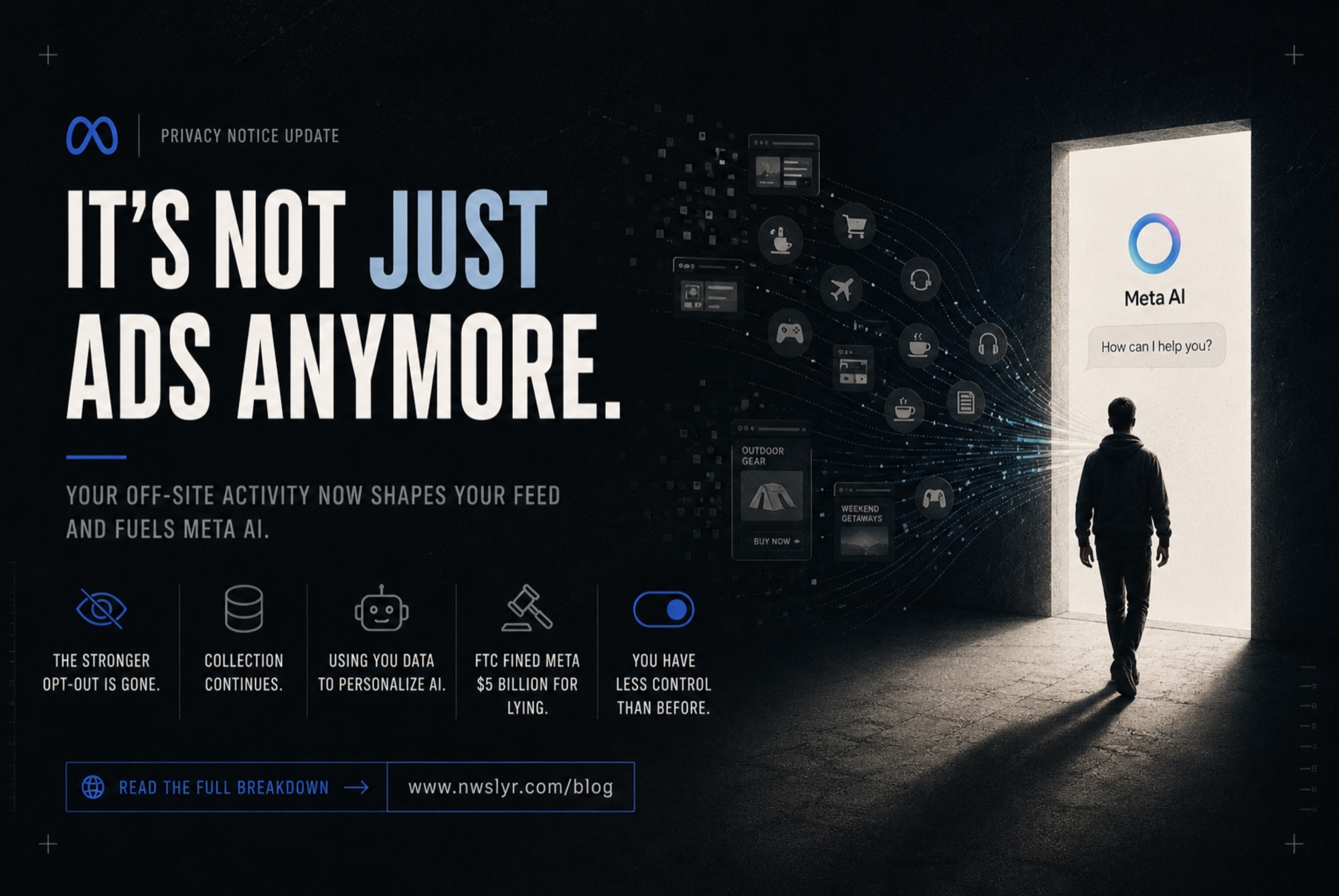
The data behind Meta’s creepy ads will now also shape your feed and what Meta AI tells you. The company calling that a routine update is the same one the FTC fined $5 billion for lying about privacy controls.
TL;DR
- Meta will use your off-site activity (its ad-tracking data) for your feed and Meta AI, not just ads. US, next month.
- The stronger opt-out is gone. Collection continues; the new toggle stops only personalization.
- Personalization, not confirmed AI training. Meta won’t confirm whether this data trains its AI.
- FTC fined Meta $5 billion for lying about privacy controls.
- Turn off: Accounts Center > Activity from other businesses. No US opt-out for AI training on public posts. The viral “opt-out form” won’t opt you out.
I got the notice on Instagram this week. What struck me first was how boring it looked.
That is on purpose. A privacy notice written in flat, sleepy language is easy to tap past. It reads like a routine settings update, one more box to clear. Most people will clear it in under two seconds.
Clear it if you want. I am not here to tell you what to do with your account. But you are agreeing to more than the notice lets on.
What it actually changes
For years, Meta has collected what you do on other websites and apps. Visit a site or buy from a business that uses Meta’s tracking tools, and your activity gets sent back to Meta in the background. Meta has used that pile to aim ads at you. That is the surveillance most people already know about, the reason a pair of shoes you glanced at once follows you around for a week.
That same off-site activity will now also shape what shows up in your feed and what Meta AI says back to you.[1][2][3] Buy a tent from a camping site, and you may start seeing camping videos in Reels and camping answers from the chatbot. Meta says it is not collecting any new data to do this. That part is true. It is also exactly how Meta makes an expansion sound like tidying up.
It is not tidying up. Meta is also taking away a setting. The old control, “Your activity off Meta technologies,” let you disconnect outside activity from your account. Meta is retiring it and pointing you to a different setting, “Activity from other businesses,” which only governs whether that activity is used to personalize what you see.[1]
Those two settings sound like the same thing. They are not. One let you cut the data off from your account entirely. The other only lets you ask Meta not to use it for personalization, which is a much weaker promise, because the businesses keep sending it and Meta keeps collecting it regardless. Meta calls this streamlining. Removing your stronger option and leaving you the weaker one is a strange thing to call streamlining.
Why the AI part stings more
Plenty of people made their peace with Meta’s ad machine a long time ago. They take the creepy ads as the cost of a free app, and that is a fair trade if you go in with your eyes open.
A second and growing group draws the line at one thing: their data being used for AI. For those people this update is worse than another shoe ad, because it takes the machine they already distrust, the one built to profile them for advertising, and runs it into the AI assistant that talks back to them. An ad is obviously an ad. An AI answer can feel like advice, or like a real conversation. When the thing shaping that answer is your behavior on other apps, the discomfort is a different kind.
The fear that follows is easy to name. Is Meta feeding this data into the training of its AI?
What Meta will say, and what it won’t
Two claims are circulating as if they were the same thing, and the blur works in Meta’s favor.
This update, in Meta’s own words, is about personalizing your feed and your AI responses.[1] Personalizing means tailoring what you, specifically, see. Training means feeding data into the model itself to make it better for everyone. Those are different things, and Meta’s announcement describes the first, not the second.
Meta openly admits to training its AI on more than most people assume. By its own privacy policy, it trains its models on your public posts and comments, and on your conversations with Meta AI, including the AI baked into the Instagram and Facebook search bars.[4][5] What it says it does not train on are your private messages with friends and family, unless you hand those messages to the chatbot yourself. Your normal WhatsApp chats are encrypted, so Meta cannot read them. But the second you message Meta AI inside WhatsApp, that is no longer a private chat. That is you sending information to Meta.[5]
Back to the off-site activity in this notice. Does it feed the training? Meta has not said either way. The setting you can switch off stops the personalization, but it does not stop the collection, and Meta’s privacy policy reserves the right to use collected data to “improve our services.” Meta AI is one of those services. That is the gap reporters have already flagged, and it is real.[6] We do not actually know.
The version of this story going around, the one that says Meta is now training its AI on everything you do online, is not something anyone has proven. I am not going to tell you it is happening.
So it comes down to trust
When a company will not answer a simple question, all you have left to go on is how much you trust it.
So how much should you trust this one.
In 2019, the Federal Trade Commission fined the company, then called Facebook, $5 billion. It is still one of the largest privacy penalties in American history. Read what it was for. The FTC found that the company had deceived its users about their ability to control the privacy of their own information. The specific deception, traced back through the earlier order it had violated, involved privacy settings that did not do what users believed they did, controls that looked like they limited who could see your data while quietly letting it flow elsewhere. The twenty-year oversight order that came out of it covers Instagram and WhatsApp too.[7]
That is the same move all over again. A company with a documented, federally penalized history of making privacy controls mean less than they appear to mean is now taking away a privacy control and telling you the replacement is just as good.
And it does not stop in 2019. When Meta began feeding Europeans’ public posts into its AI, the privacy group NOYB found the company had buried the notice so well that only about four in ten Instagram users even remembered seeing it, paired with an email written to be ignored.[8] When NOYB asked people what they wanted, only seven percent were fine with their data being used to train Meta’s AI.[8] Last year, when Meta announced it would start using your private AI chats to target ads with no way to opt out, a coalition of thirty-six privacy, consumer, and civil rights groups asked the FTC to step in and block it.[9][10][11]
That is the track record: years of getting caught, and paying for it.
So no, I cannot prove Meta is training its AI on your browsing history. But proving it was never the point. What matters is whether you should take the word of a company that has been caught, repeatedly and expensively, lying about your privacy. When that company hands you a notice padded with soft words like “streamlining” and “not collecting new data,” and then goes quiet on the one question that matters, the quiet tells you something. From a company with this history, it tells you plenty.
What you can actually do
To turn this specific change off, open Accounts Center, go to your information and permissions, find “Activity from other businesses,” and choose not to allow it. That stops Meta from using your off-site activity to personalize your ads, feed, and AI responses. It does not stop the data from being collected.
What you cannot do, if you are in the United States, is opt out of Meta training its AI on your public posts. There is no button for it. As an AI ethics researcher at Berkeley told PolitiFact, the country has no federal privacy law, so Americans have no standard right to refuse AI training.[5] Europeans at least have an objection form, weak as it is.[4] Americans do not have even that.
A form keeps circulating that people pass around as the way to opt out of Meta’s AI training. It is not. That form is for reporting when Meta’s AI coughs up your personal information in an answer.[12] Filling it out opts you out of nothing. The only real lever you have over the chatbot training is to stop talking to the chatbot.
Last words
Delete Facebook. Delete Instagram. Or keep them and leave all of this exactly where Meta wants it. I am not going to pretend one of those is the right answer, because it depends on what the apps are worth to you, set against what you give up to keep them.
What I would not do is decide it blind. These notices are built to be tapped past, and that is the whole point of them. If you read this far, you are already past that. You know what the change does, and what Meta will not say about it.
That last part is what I keep coming back to. Meta has not earned anyone’s trust, and the trend has only gotten worse, not better. Each new change asks you to hand over a little more and wraps it in language built to slide right past you.
So whatever you decide today, keep half an eye on this company. Watch what it announces, and watch what it rolls out without saying anything. The next change is already on its way, and it will be built to be skipped too.
Sources
- Meta Newsroom, “Better Personalization and Changes to Controls for Your Activity From Other Businesses,” June 9, 2026. https://about.fb.com/news/2026/06/better-personalization-and-changes-to-controls-for-your-activity-from-other-businesses/
- Social Media Today (Andrew Hutchinson), “Meta will use off-site activity to customize feed and AI responses,” June 9, 2026. https://www.socialmediatoday.com/news/meta-will-use-off-site-activity-to-customize-feed-and-ai-responses/822442/
- The Verge, “Meta will use your activity on other websites to personalize your feeds,” June 2026. https://www.theverge.com/tech/946744/meta-website-activity-personalize-feeds
- Built In, “How to Opt Out of AI Training: 10 Ways to Protect Your Data,” April 2026. https://builtin.com/articles/ai-training-data-opt-out
- Al Jazeera, “Are tech companies using your private data to train AI models?”, November 24, 2025. https://www.aljazeera.com/news/2025/11/24/are-tech-companies-using-your-private-data-to-train-ai-models
- Android Authority, “Meta now wants to use your activity from other websites to personalize its AI,” June 10, 2026. https://www.androidauthority.com/meta-activity-external-apps-websites-personalize-ai-home-feeds-3676116/
- Federal Trade Commission, “FTC Imposes $5 Billion Penalty and Sweeping New Privacy Restrictions on Facebook,” July 24, 2019. https://www.ftc.gov/news-events/news/press-releases/2019/07/ftc-imposes-5-billion-penalty-sweeping-new-privacy-restrictions-facebook
- NOYB, “noyb survey: only 7% of users want Meta to use their personal data for AI,” August 2025. https://noyb.eu/en/noyb-survey-only-7-users-want-meta-use-their-personal-data-ai
- Reuters, “Meta to use AI chats to personalize content and ads from December,” October 1, 2025. https://www.reuters.com/business/media-telecom/meta-use-ai-chats-personalize-content-ads-december-2025-10-01/
- EPIC, “Advocates Urge FTC to Halt Meta’s Plan to Use AI Chatbot Data for Ads,” 2025. https://epic.org/press-release-advocates-urge-ftc-to-halt-metas-plan-to-use-ai-chatbot-data-for-ads/
- The Record (Recorded Future News), “Privacy advocates see risk in new Meta policy that uses AI chats to serve targeted ads,” December 2025. https://therecord.media/privacy-advocates-see-risks-meta-ai-ad-targeting
- Norton, “How to opt out of Meta AI: Options to protect your data,” 2025. https://us.norton.com/blog/ai/how-to-opt-out-of-meta-ai