Huxe Did Everything Right. It Wasn't Enough.
The ex-NotebookLM team raised $4.6 million, shipped a personalized AI audio briefing app, earned glowing reviews, and shut down eleven months later. The window just wasn't there.
This email landed in my inbox this afternoon. I barely remembered signing up.
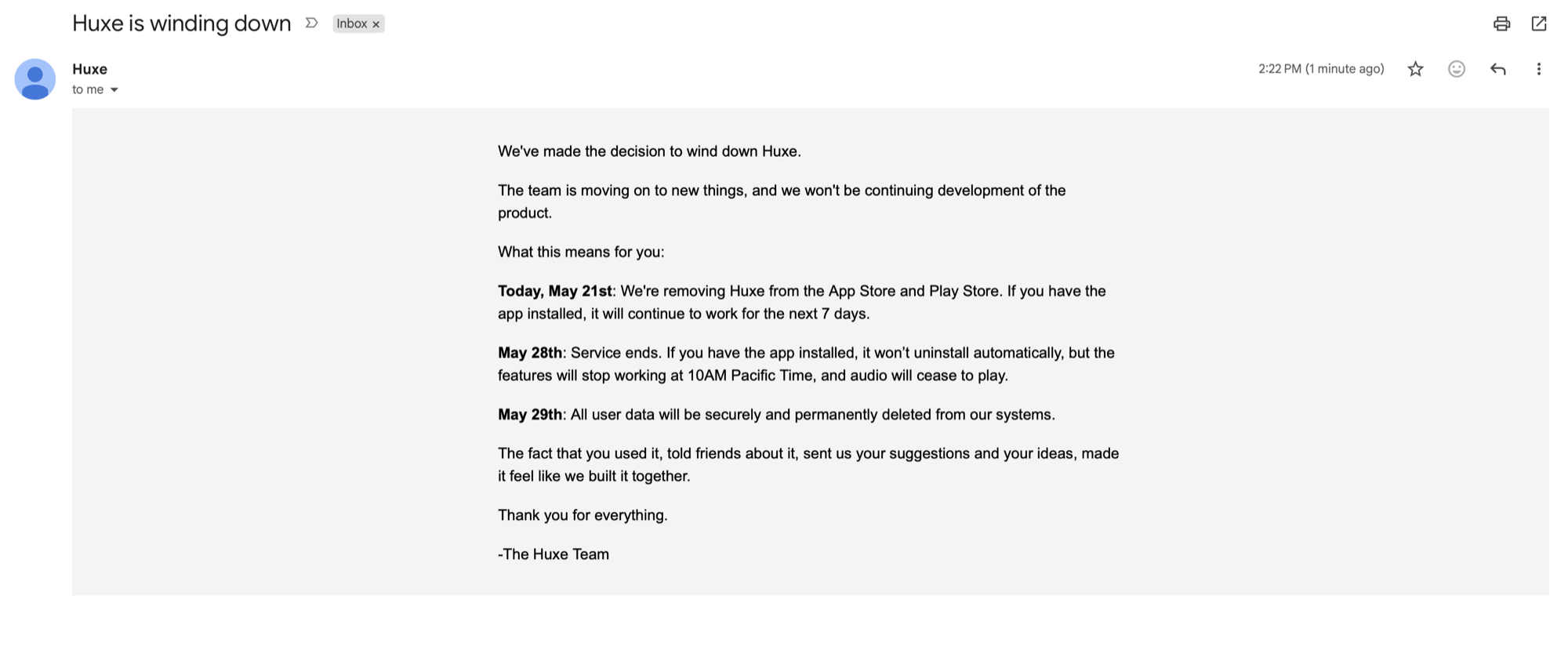
Huxe was one of those apps I’d signed up to try during early access, used a couple of times, thought “this is cool,” and then never opened again. A personalized audio briefing that read your email and calendar and turned it into a morning podcast with AI hosts you could interrupt and talk to. The shutdown timeline is blunt: app removed from stores today, service ends May 28, all user data deleted May 29.
The app first opened to early testers in June 2025 and launched publicly in September 2025. Eleven months from first users to final email. Small AI startups shut down all the time now, but this one is worth paying attention to because this particular team did virtually everything right, and the outcome was the same.
The team was as good as it gets
Huxe was founded by Raiza Martin, Jason Spielman, and Stephen Hughes, the product lead, design lead, and a software engineer from the original Google NotebookLM team. They’d been there since it was still called Project Tailwind, an experimental Google Labs project in 2023. NotebookLM’s Audio Overviews, the feature that went viral in late 2024 and made people genuinely excited about AI-generated podcasts, was their work.
They left Google in December 2024 to build their own thing. The bet was that the best version of personalized AI audio wasn’t a feature inside a research tool but the whole product. A standalone app that pulls from your inbox and calendar, generates a five-minute morning briefing, and lets you interact with the AI hosts in real time. They started with a B2B chatbot, pivoted to consumer audio in March 2025, and had the app in testers’ hands by June.
The seed round was $4.6 million from Conviction, Genius Ventures, Figma CEO Dylan Field, and Google Research’s chief scientist Jeff Dean. Coverage from XDA Developers, TechCrunch, and Android Police was overwhelmingly positive. One review site reported 92% weekly retention and 65% voice engagement. Nine employees building a product that people who tried it seemed to genuinely like.
This wasn’t a bad bet by unserious people.
The category moved out from under them
When Huxe launched in mid-2025, personalized AI audio briefings were a fresh concept. By early 2026, the same idea was showing up everywhere.
NotebookLM kept expanding with interactive audio, video overviews, and a deep research mode. Apple Intelligence started enabling shortcut-based daily briefings on iOS. ChatGPT’s voice mode became a go-to for people who wanted hands-free morning catch-ups. And two days before Huxe’s shutdown email, Google announced “Daily Brief” at I/O 2026, a personalized morning digest built directly into the Gemini app that pulls from Gmail, Calendar, and Tasks. It started rolling out to subscribers the same day.
Nobody copied Huxe. What happened is that the insight Huxe was built on, that people want a personalized audio-first summary of their day, turned out to be the kind of obvious-in-retrospect idea that multiple teams arrive at independently once the underlying models are good enough. The technology unlocks a capability, and everyone sees the same opening at roughly the same time.
A standalone app with nine employees can’t out-distribute a platform with 900 million monthly users shipping the same feature natively. Not because the standalone app is worse. Huxe’s interactive “Join” feature, where you could interrupt the AI hosts mid-conversation, was genuinely ahead of what the bigger players offered at the time. But when the feature ships inside the app people already open every morning, the standalone version has to be dramatically better to justify a separate download, a separate login, and a separate set of permissions to grant. “Somewhat better” doesn’t clear that bar.
The window is shrinking
A year ago, the playbook for AI startups still assumed you had time. Big companies were slow. They were shipping demos, not products. Find a use case, build fast, lock in users before the platforms catch up.
That time buffer is compressing. The gap between “interesting research concept” and “shipped to hundreds of millions of users” has gone from years to months. Features that would have taken a large company 18 months to productize in 2023 are now shipping in single-digit months.
Huxe moved fast by any normal startup standard. Founding to early access in six months. Public launch three months after that. But the category was moving at platform speed, which is a different clock entirely.
What sticks with me
The farewell email ends with: “The fact that you used it, told friends about it, sent us your suggestions and your ideas, made it feel like we built it together.”
That’s not boilerplate. That reads like people who cared about their product and the people using it.
Raiza Martin, Jason Spielman, and Stephen Hughes shipped from zero to public launch in under a year with nine people and less than five million dollars. They navigated a pivot from B2B to consumer, earned real traction, and built features that were ahead of the curve. Whatever they do next, that record speaks for itself.
The part I keep thinking about is what this means for anyone else building a standalone AI app right now. Product quality matters, obviously. But it might not be enough on its own when the underlying capability becomes widely available at the same time your app does. You need the timing, the distribution, and a thesis that can’t just be absorbed as a feature toggle inside someone else’s platform.
None of that means you shouldn’t build. It just means you should be honest about the ground you’re standing on when you start.
Sources: TechCrunch on Huxe’s launch and $4.6M raise; XDA Developers on the early access and NotebookLM connection; Yahoo Finance on the B2B-to-consumer pivot; Google’s Daily Brief announcement at I/O 2026; 9to5Google on Gemini’s 900M users and app redesign; TechCrunch on Gemini’s I/O 2026 updates; The Data Exchange interview with Raiza Martin; Android Police review.