The Government 86’d Fable 5. Anthropic Might Have Been Saved by the Bell.
June 13, 2026
Four days ago I wrote about running Fable 5 against one of my own apps and watching it switch itself off mid-audit. At the time, the biggest concern was a classifier that could not tell defensive security work from offensive. That concern aged fast.
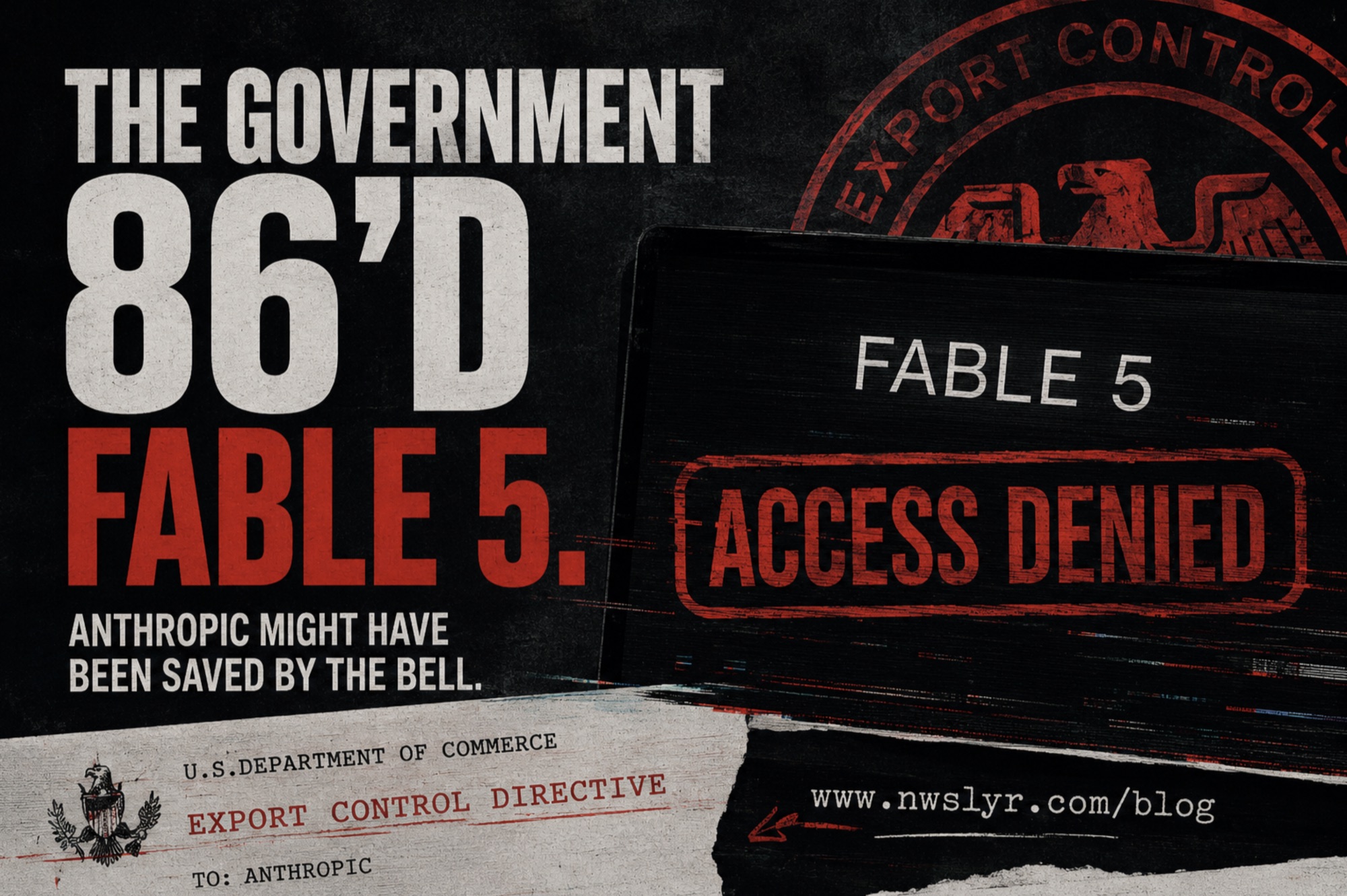
On Friday evening at 5:21 p.m. Eastern, the U.S. government handed Anthropic an export control directive ordering it to suspend all access to Fable 5 and Mythos 5 for any foreign national, inside or outside the United States, including Anthropic’s own foreign-national employees.[1] Because the company cannot reliably separate foreign nationals from the rest of its user base in real time, the practical result is a hard shutoff of both models for every customer on Earth.
A model widely considered the most capable publicly available AI went dark in an evening.
What the government did
Commerce Secretary Howard Lutnick sent a letter to Anthropic CEO Dario Amodei imposing export controls on both models. Under the order, any export, re-export, or domestic transfer of Fable 5 or Mythos 5 now requires a license. Failure to comply carries financial and civil penalties.[2]
An administration official told Axios that the Commerce Department acted after another company claimed it had found a way to jailbreak Mythos, alarming officials about national security risk. The administration tried to get Anthropic to pause the release before launch and failed, which prompted the letter.[2]
The official added that the models need to remain locked down until the government’s national security apparatus is “hardened,” which could take a few weeks.[2]
What Trump said
Here is what stands out: Trump himself has said nothing about this one. Not on Truth Social, not from a podium, not through a spokesperson.
That is unusual. In February, after Anthropic refused the Pentagon’s demand to use its AI for “all lawful purposes,” Trump published a lengthy Truth Social post calling the company “radical left” and “woke,” accusing its leadership of putting American lives at risk, and threatening criminal consequences.[3] He ordered every federal agency to stop using Anthropic products and gave them six months to phase out. That was loud. It was personal. It had his name on it. In early March, the Pentagon formally declared Anthropic a “supply chain risk” and blacklisted its products from military use.[4]
This time, the action came through Lutnick at Commerce, citing export control authority, with no public statement from the President.
It is worth noting the sequence. An executive order earlier this month established voluntary pre-deployment testing for frontier AI models, a framework whose voluntary, no-licensing structure David Sacks specifically secured during his tenure as White House AI and crypto czar to avoid what he called “regulatory capture.”[2] The testing partnership between Anthropic and Commerce’s Center for AI Standards and Innovation was already in place. The administration asked Anthropic to pause the release; Anthropic declined and shipped Fable 5.[2] The export control letter followed days later, imposing exactly the kind of mandatory licensing regime the voluntary framework was built to prevent, just through a different legal authority. Whether that sequence reflects retaliation or a genuine security process moving on its own timeline depends on facts that are not yet public.
What Anthropic said
Anthropic complied, pulled both models, and published a detailed statement disagreeing with the reasoning.[1]
The company says the government gave only verbal evidence of a potential narrow, non-universal jailbreak: essentially asking the model to read a specific codebase and fix software flaws. Anthropic reviewed what it believes is the underlying report and concluded that the capability it demonstrated is widely available from other models, including OpenAI’s GPT-5.5, and is the same capability that defenders use every day to keep systems safe.[1]
On safeguards: Anthropic says its pre-launch red-teaming ran thousands of hours across government agencies, the UK AI Safety Institute, third-party organizations, and internal teams. No tester found a universal jailbreak. The company said it suspects that perfect jailbreak resistance is not currently possible for any model provider and that it adopted a defense-in-depth strategy: make jailbreaks narrow or expensive to produce, combine that with monitoring, and use the 30-day data retention requirement to detect and respond to successful attacks.[1]
Anthropic’s closing argument: if the standard applied here were applied across the industry, it would essentially halt all new model deployments for all frontier providers.[1]
What others are saying
The reaction is split in a way that reveals the fault lines.
Dean Ball, an AI policy expert who briefly served in the Trump administration, called the move “cartoonish” and pointed to what he sees as a contradiction: an administration that wants to export advanced AI chips to China also wants to prevent Britain and every other non-American country from using its best AI models.[4]
David Sacks, the former White House AI and crypto czar who now co-chairs the President’s Council of Advisors on Science and Technology, has publicly called Anthropic “woke” and “leftist” and accused the company of running a regulatory capture strategy based on fear-mongering.[4] Several key Trump technology policy advisors, including Sacks and Pentagon undersecretary Emil Michael, have been openly critical of Anthropic and its leadership for months.[4]
And then there is the irony argument. When Anthropic released Mythos, it called the model too dangerous for public use. When it released Fable 5 four days ago, it highlighted the safeguards it had built to keep users away from Mythos’s full capabilities. Some observers now say the company described a threat so convincingly that the government decided to act on it.[4]
The governance implication cuts deeper than the irony. If a company’s own safety disclosures become the basis for government action against it, every other lab learns to say less about what their models can do. That is the opposite of what AI governance needs. Transparency about model capabilities is the foundation that safety testing, red-teaming, and informed regulation are built on. A precedent where honesty about risk becomes a competitive liability pushes the entire industry toward less disclosure, not more.
What this actually means
There is a side of this story where the government is doing its job. Mythos is, by Anthropic’s own account, the most capable model the company has ever built, and it was originally restricted from public release because of what it could do in cybersecurity, biology, and a few other areas. If a credible jailbreak surfaced and the government moved fast to contain it while it assessed the risk, that is what export control authority exists for. The administration may also hold classified evidence it has not disclosed.
The problem is what happened around the edges. The directive arrived at 5:21 p.m. on a Friday. Anthropic says it did not include specific details of the national security concern.[1] The jailbreak claim came from an unnamed company and has not been published. And no equivalent order has gone to any other frontier provider, including OpenAI, whose GPT-5.5 has a public cyber evaluation and remains live.[1]
A government letter can turn your production model off overnight with no advance warning and no published timeline for restoration.
AI builders and engineers woke up Saturday morning to Fable 5 being gone. Everyone who spent the last four days integrating it, testing it, building workflows around it, planning products on top of it, woke up to a locked door. That is not a deprecation notice with a migration window. That is not a pricing change you can plan around. No warning or chance to get ready. Gone.
I will add one observation from my own use. On June 10, the day after launch, I ran Fable 5 on a single task. The model autonomously spawned 121 agents and burned through 5.7 million tokens in under fifteen minutes. I did not ask it to spin up 121 agents. It decided that on its own. The result was impressive. The amount of effort and token use to accomplish the task felt astronomical in comparison to Opus 4.8 and even ChatGPT-5.5. At Fable 5 API rates, 5.7 million tokens multiplied by millions of users running the model on real work, that’s just insane. The question of whether Fable 5’s economics were sustainable at scale seems too on the nose to think that this was just the government wanting it shut down.
The implementation also had rough edges. When I started using Fable 5, my weekly model rate limit window quietly shifted from five days to six with no notice. Small failures showed up throughout: the kind of inconsistencies that feel like a product pushed to market before it was ready. Worse than an Apple Developer beta release (looking at you iOS 27/Golden Gate). None of that is proof of anything. But as a user who was actively building on the model, the overall experience did not feel like a finished product running at steady state. It felt excessively wasteful. I had already gone back to Opus 4.8 because I was achieving the same results with orders of magnitude less.
But this is not an Anthropic problem alone. This is an AI industry problem. Everyone actively using AI understands that the subsidies are not sustainable, thus the rug will get pulled from under us when the IPOs finally launch. Also, if the government can do this to Anthropic’s models on a Friday evening, it can do it to OpenAI’s models next Friday. It can do it to Google’s. Any frontier model that crosses a capability threshold the government decides is sensitive can be pulled from under every customer on Earth with a single letter. AI companies already had the power to flip a switch and remove a model from under you. Deprecations happen, rate limits change, pricing moves. Now the government has that power too, and it used it with no advance warning, no published evidence, and no timeline for restoration.
Another way of looking at all this, the government’s action was a blessing in disguise for Anthropic. Saved by the bell.
That should scare everyone building on AI, not just the people building on Claude. If you are a founder raising money on an AI product, an enterprise buyer evaluating a migration to AI infrastructure, or an investor valuing an AI company at nearly a trillion dollars, you now have to price in the possibility that your core model gets pulled overnight with no recourse. The trust that AI infrastructure was something you could stake a business on took real damage this week. People in this industry have been asking what it would take to pop the AI bubble. A government that can 86 your production model on a Friday night and offer no timeline for getting it back might be the answer. That is not speculation. That is what happened. And it is creating real fear.
Anthropic filed confidentially for a public listing earlier this month. A recent funding round valued the company at $965 billion.[4] This entire event is now part of that story, alongside the Pentagon blacklist and the ongoing federal lawsuit. Whether investors read this as a regulatory environment that will stabilize or one that will keep escalating is an open question.
Where this sits right now
The government has not published the jailbreak claim or named the company that made it. Anthropic says it reviewed the underlying report and that the capability shown is available in competing models that remain online.[1] If the details come out, the technical community will settle that question fast.
An administration official told Axios the lockdown could last a few weeks.[2] Anthropic says it is working to restore access.
So the immediate question is narrow: is this an export control policy that will apply to any frontier model that crosses a capability threshold, or is it specific to Anthropic. The answer matters for everyone building on frontier AI, not only the ones building on Claude.
References
[1]: Anthropic, “Statement on the US government directive to suspend access to Fable 5 and Mythos 5,” June 12, 2026. Covers the directive receipt at 5:21 p.m. ET, the scope of the export control, Anthropic’s review of the jailbreak claim, the defense-in-depth strategy, the red-teaming scope, and the industry-standard argument. anthropic.com/news/fable-mythos-access
[2]: Alex Isenstadt and Maria Curi, “Scoop: Trump admin blocks foreign access to Anthropic’s most powerful AI,” Axios, June 12, 2026. Reports the Lutnick letter, the jailbreak claim from another company, the failed attempt to delay the release, the licensing requirement, the “few weeks” timeline, and the voluntary testing executive order. axios.com
[3]: “Trump says he plans to order federal ban on Anthropic AI after company refuses Pentagon demands,” Fox News, February 2026. Covers Trump’s Truth Social post ordering all federal agencies to stop using Anthropic products, his characterization of the company, and the six-month phase-out directive. foxnews.com
[4]: “Anthropic disables Fable and Mythos AI models following U.S. government export ban,” Fortune, June 13, 2026. Covers Dean Ball’s “cartoonish” assessment, the David Sacks and Emil Michael criticisms of Anthropic, the “reaping what it had sown” argument, the $965 billion valuation, the confidential IPO filing, and the Pentagon supply-chain-risk designation. fortune.com