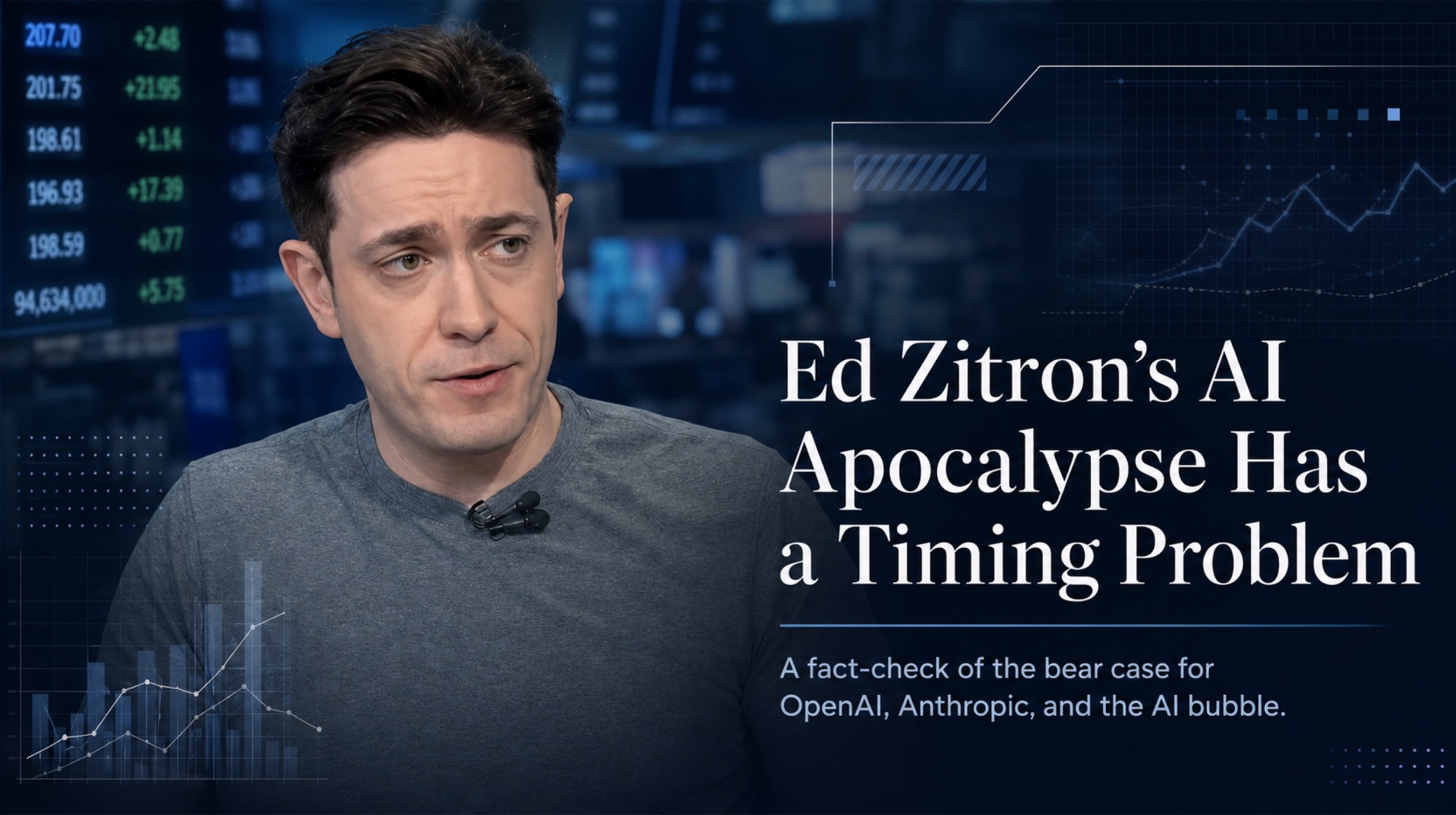
Ed Zitron’s AI Apocalypse Has a Timing Problem
TL;DR
- Ed Zitron’s financial case against the AI industry is strong. His bigger claim, that the technology itself is a dead end, is weak, and he keeps using the first to smuggle in the second.
- The money problem is real. OpenAI spent $34 billion in 2025 and is chasing a $600 billion compute build-out, and Oracle is carrying $638 billion in AI backlog against negative cash flow. The spending is running years ahead of any proven way to pay for it.
- His timing does not hold up. Collapse was “beginning” in September 2024, then it was “Peak AI,” then February 2027, and by mid-2026 he was still writing guides to a crash that has not arrived. The clock keeps moving forward.
- The evidence is mixed, not apocalyptic. OpenAI is strained but still growing, with more than 900 million weekly users and $2 billion in monthly revenue, and Nvidia just posted record sales with no slowdown. The real danger is a financing bust. The technology itself is not going anywhere.
- The rhetoric flattens real distinctions. “Hallucinations” become a veto on every use case, “no ROI” skips over evidence that cuts both ways, and the cost of a fixed capability keeps falling even as frontier bills climb.
- The honest version is narrower and more useful: AI is here to stay, its economics are genuinely strained, it still needs human supervision, and there is a real capital bubble sitting on top of a real technology.
The bear case that became a brand
Zitron’s best argument is simple. The industry is spending money far faster than it has shown it can earn back, and for two years he has made that point louder than almost anyone else writing about tech.
The figures are real. Reuters, citing audited numbers first reported by the Financial Times, put OpenAI’s 2025 spending at $34 billion, with roughly $19 billion of that going to research and development and nearly $6 billion to sales and marketing.[1] Reuters also reported that the company expects about $600 billion in compute spending through 2030, that the cost of running its models rose fourfold during 2025, and that its adjusted gross margin slid from 40 percent to 33 percent.[2]
Oracle sits inside the same story. For fiscal 2026 it reported $638 billion in remaining performance obligations and negative free cash flow of $23.7 billion, and it said most of that backlog came from large AI contracts, with customers prepaying or supplying $75 billion of the GPU hardware.[3] It plans to raise close to $40 billion in debt and equity in fiscal 2027, and its capital spending that year could reach $95 billion.[4] That is not hype; it is a balance sheet.
Give him credit for this. Zitron dragged the AI conversation back to the things that decide whether a company survives, which are contracts, cash burn, power, chips, debt, and gross margin. Too much coverage still treats a slick demo as destiny. He never has. He wants to know who pays the bill, and that instinct is the right one.
Then he takes one more step, and the step is where the trouble starts. A sharp financial critique becomes a sweeping claim that the whole technology is a dead end. The numbers carry the first argument. They do not carry the second.
When the clock started
This did not begin with the latest CNBC hit. Zitron has been writing some version of the bubble case for more than two years, and the paper trail is easy to follow.
In February 2024, in a piece called “Subprime Intelligence,” he called generative AI “impossibly unreliable” and argued it burned far more money than it made. He also laid out the circular cloud problem, where Big Tech invests in the model companies that then hand much of that money straight back as cloud spending.[5] That June, in “The Rot-Com Bubble,” he wrote that the bubble would “inevitably pop,” and warned the damage would land fast.[6]
September 2024 is where he sharpened it. In “The Subprime AI Crisis” he wrote that the boom was unsustainable and would collapse, that “the tides are rapidly turning,” and that “multiple pale horses of the AI apocalypse” had emerged and signaled the beginning of the end.[7] By December, in “Godot Isn’t Making It,” the framing had hardened into something close to a verdict: the industry had reached “Peak AI,” transformer-based generative AI was a dead-end technology, and the whole sector had built itself around products that cost more to serve than anyone would pay for them.[8]
Then the date moved. By August 2025, in “AI Bubble 2027,” he allowed that the bursting might “take a minute,” that the collapse could stretch across a year or more, and that one venture capitalist’s funding math pointed to February 2027 as the moment things might have “truly collapsed.”[9] That shift does not prove him wrong. Bubbles really can outlast the people calling them, and a good bear is often early.
Still, look at the shape of it. The collapse was beginning in 2024. Then the industry was at Peak AI. Then the real break might come in 2027, and by June 2026 he was publishing multi-part guides to how the collapse might unfold, what might trigger it, and what it would cost the rest of us.[10] The end keeps getting rescheduled.
What happened, and what did not
Some of his calls have held.
OpenAI’s real financial picture is worse than its public confidence suggests. Reuters reported in April 2026 that the company had missed its own revenue and user-growth targets, and that CFO Sarah Friar had told other leaders she was worried OpenAI might not be able to cover its future compute contracts if revenue did not pick up.[11] OpenAI disputed that account. In a joint statement, Altman and Friar called the report “ridiculous” and said they were “totally aligned on buying as much compute as we can.”[12] The denial does not erase the strain underneath it. Reuters has also reported that OpenAI does not expect to be profitable until 2030.[13] Those facts fit Zitron’s thesis, and there is no honest way around them.
The infrastructure risk is real too. In June 2026 the Bank for International Settlements, the institution central banks answer to, warned that intense competition could push firms to overinvest in AI projects whose returns are still uncertain, leaving the whole sector exposed if the payoff comes in short.[14]
And yet the larger collapse has not happened. OpenAI filed confidentially for a U.S. IPO in the first half of 2026, with Reuters reporting a target valuation as high as $1 trillion, and the company has said ChatGPT passed 900 million weekly active users and 50 million consumer subscribers.[15] In March 2026 it said it was generating $2 billion in revenue a month, up from a billion a quarter at the end of 2024.[16]
Nvidia has not cracked either. In the quarter it reported in May 2026 it posted record revenue of $81.6 billion, up 85 percent year over year, with data-center revenue of $75.2 billion, up 92 percent.[17] Reuters noted that its results and forecast showed the feared AI slowdown simply was not turning up in the numbers.[18]
None of that proves Zitron wrong about the bubble. It shows the picture is mixed, and that two things can be true at once. OpenAI can be financially strained and still growing fast. Nvidia can be exposed to a capex cycle and still printing cash. Oracle can be carrying real risk and still sitting on years of contracted demand. AI can be overbuilt and permanent at the same time. That last pairing is where the apocalyptic version of the argument falls apart.
The Michael Burry temptation
Every bubble story wants its Michael Burry, the investor who bet against subprime mortgages before the 2008 crash and became the hero of “The Big Short.”[19] The appeal is obvious. One person sees the rot, gets laughed at, waits far longer than seems reasonable, and is finally proven right.
Whether Zitron wants that role, I can’t say. But his public posture has the same silhouette: early warning, mounting frustration, relentless repetition, and the promise that delay is not disproof. His audience already knows the ending it is rooting for. The bear wants to have called it first.
That pull can bend the work. Anyone determined to be right about a crash has to keep explaining why it hasn’t come, and there are two ways to do that. One is honest, because bubbles genuinely can last longer than skeptics expect. The other becomes a reflex, where the date slides, the trigger changes, the language heats up, and every fresh data point gets folded into the same prophecy. That second habit is the risk with Zitron now. He may have spotted a real financial problem early and also boxed himself into defending the most extreme version of that early call.
The repeated argument problem
His writing has a rhythm you start to hear. The same words cycle through: hallucinations, no ROI, bubble, scam, con, grift, token burn, circular demand, dead end, fake revenue. Some of them point at real things. Token burn is real, circular demand is a fair worry, hallucinations happen, subsidized pricing is everywhere, and OpenAI’s margin problem is not imaginary.
The trouble is that a real term can quietly stop being an argument and start being filler.
Take “AI Doesn’t Have ROI.” In it, Zitron argues that nobody can measure AI’s return or true task cost, because the models hallucinate and agentic systems pile on too many moving parts, and he asks why anyone would pay for a tool when they can’t measure how good it is, what it costs, or what it returns.[20] It is a fair question. It is not a proof that the return is zero.
The evidence is split, and the split is the point. A study of 5,172 customer-support agents in the Quarterly Journal of Economics found that access to a generative AI assistant raised productivity by 15 percent on average.[21] A METR controlled trial found the opposite in a different setting: experienced open-source developers took 19 percent longer when they used AI tools on codebases they already knew cold.[22] So the honest reading is that AI helps in some work and hurts in other work, and the answer turns on the task, the worker, the review step, the model, and what it costs to be wrong.
The hallucination veto
Zitron is right that hallucinations are still a problem. When OpenAI shipped GPT-5.5 Instant, it said the model produced 52.5 percent fewer hallucinated claims than GPT-5.3 Instant on high-stakes prompts in medicine, law, and finance, and 37.3 percent fewer inaccurate claims on the difficult conversations users had flagged.[23] The gains are real, and the problem is not solved. Stanford’s 2026 AI Index put hallucination rates between 22 percent and 94 percent across 26 leading models on a benchmark built to test false user beliefs, and OpenAI’s own system card treats factuality as an open evaluation problem, hardest on the trickiest prompts.[24][25]
The mistake is using the word as a universal veto. A hallucinated legal citation can wreck a court filing. A hallucinated medical answer can hurt someone. A hallucinated software dependency can open a security hole. A weak first draft of a marketing email is not that, and neither is a bad support suggestion that a human catches before it reaches the customer. Risk changes with the workflow, and so does the cost of checking the output.
That is why “hallucinations” can turn into a cheap move. The word sounds technical and it sounds fatal, and leaning on it lets the writer skip the harder job of sorting the high-risk uses from the low-risk ones. Zitron should keep raising it. He should stop treating it as the end of every business case.
The audience already knows the bill is weird
The apocalyptic style also misreads the market it is lecturing.
People who use these tools every day already know the economics are not clean. They watch token spend get away from them. They know long-context work is expensive, that agents loop and fail and retry, and that a $20 or $200 subscription is nowhere near the real cost of heavy inference. They know serious enterprise AI needs routing, caching, retrieval, evals, human review, security checks, and governance around all of it. That is not secret knowledge anymore.
Zitron sometimes writes as if the industry is still under a spell and he alone has seen the invoice. That was closer to true in 2023 than it is in 2026. The useful question is no longer whether AI is expensive, because serious users already know it is. The question is whether model routing, cheaper inference chips, caching, smaller models, better evals, smarter workflow design, and falling fixed-capability costs can improve the math fast enough to matter.
Epoch AI has found steep drops in inference prices for a fixed level of benchmark performance, including a roughly 40-fold annual fall in the price of reaching GPT-4-level results on one science benchmark.[26] A related paper built on benchmark-price data found that the cost of hitting a given score dropped somewhere between 5 and 10 times per year across knowledge, reasoning, math, and software-engineering tests.[27] None of that means total AI spending falls. It may climb, because people keep asking for harder tasks, longer context, more agents, more retries, and more verification. Both can be true at once: the price of a fixed capability drops while frontier usage gets more expensive. That distinction is exactly the kind of thing his rhetoric tends to flatten.
The Burry problem without the Burry trade
A crash call gets much easier to defend once it has no expiration date. Say the bubble will burst next quarter and it doesn’t, and the claim is simply wrong. Say instead that it is already bursting, then that the real collapse may take a year, then that 2027 is the window, then that the triggers are still forming, and the claim slips out of reach of ever being wrong. That does not make it false. It does make it slippery.
His language was already severe in 2024. By that September he said things were beginning to collapse.[28] By August 2025 the collapse might take until around February 2027 to fully play out.[29] By June 2026 he was still writing guides to how it might happen.[30] That is not a clean prediction record; it is a thesis that keeps evolving to survive.
The fair version is that Zitron flagged real pressure points early, above all OpenAI’s dependence on outside financing and cheap compute. The unfair version is the move he keeps making, where the mere existence of those pressure points means every month without a collapse just proves the collapse will be bigger when it finally lands. That is how bear-market writing turns into comfort food. It hands the audience the feeling of being early, even as the calendar keeps sliding.
What critics get right
Kelsey Piper, writing in The Argument, lands the central objection: an AI bubble does not prove AI is useless. The dot-com crash did not prove the internet was fake. It proved that a lot of internet companies were bad investments.[31] The analogy holds because it keeps two things separate. A technology can outlive its bubble. A product can be useful while the stocks around it are wildly overpriced. Infrastructure can be overbuilt and still matter a decade later.
Piper also argues that Zitron’s case has drifted from a business critique toward accusations of outright fraud and deception.[32] That matters, because fraud is a heavier charge than bad economics, and it takes more to support than aggressive spending, rosy projections, or a leaked revenue figure.
WIRED pointed at a different tension when it profiled him as one of the loudest anti-AI voices in the business while he also runs EZPR, a tech public relations firm.[33] That does not make him wrong. Someone who works around hype for a living can read hype better than most. It does help explain why some readers hear a performance underneath the anger. The sharpest criticism is the plainest one. His finance work is genuinely useful, but the totalizing frame around it hands AI boosters an easy exit. Say AI has no use and they point at real users. Say instead that AI has bad economics at current scale, and suddenly they owe you a real answer.
The pro-AI case still has to face the math
Being bullish on AI should not mean pretending the economics are fine, because they are not.
Token spend, inference cost, training cost, data centers, power constraints: all real, all growing. Enterprise deployment is slower than the demos promise, legal and security review are not going anywhere, today’s leaders may not be the ones standing in five years, and some of the companies raising money right now will fail. None of that adds up to a dead end.
AI is already woven into the daily work of millions of people. Reuters, citing Sensor Tower estimates, reported that ChatGPT crossed a billion monthly active app users in May 2026.[34] OpenAI says more than 9 million paying business users now rely on ChatGPT for work, on top of its 50 million-plus consumer subscribers.[35] Usage is not profit, granted. But usage at that scale is not nothing, and it is not a hallucination or a press-release trick.
The technology is staying. The financing model may not. Prices will move, model architectures will change, workflows will get more constrained, some labs will lose, some infrastructure providers will be left holding assets nobody wants, and some features will quietly disappear once the subsidies end. For a young computing platform, that is an ordinary future. It is not the end of the world.
Why the apocalyptic version is a disservice
The doom framing gets attention, and it also makes the public conversation dumber. It tells ordinary users they are fools for leaning on a tool that already helps them. It tells builders the whole category is doomed instead of asking which specific workflows can carry the cost. It tells investors the only two options are scam or salvation, and it tells companies to argue about belief when they could be measuring value. That feels good to the bears. It does not help anyone make a better decision.
The stronger critique is also the harder one to dismiss: AI is here, it is useful, it is flawed, and the money behind it may still be wrong. That sentence does not cut cleanly into a television segment. It is also much harder to wave away.
The charge that sticks
Zitron may well be proven right about a major AI financing bust. He has named the real weak spots, from OpenAI’s losses and hyperscaler capex to Oracle’s exposure, token pricing, neocloud financing, and the widening gap between AI revenue and AI infrastructure spending. Being early, though, is not the same as being precise.
He has been calling collapse in one form or another since 2024, and in that time the industry has not collapsed. It grew, raised more money, filed for IPOs, added hundreds of millions of users, and got central bankers worried about overinvestment, all at once. That is not a clean win for anyone.
The problem was never that he is bearish. It is that the bear case got too apocalyptic to stay sharp. He talks as if hallucinations close the argument; they don’t. He talks as if bad economics prove bad technology; they don’t. He talks as if every delay strengthens the prophecy, when it might instead mean the thesis needs trimming. The truer story is narrower and more useful: AI is good enough to stay, expensive enough to strain margins, unreliable enough to need a human in the loop, and hyped enough to have built a serious capital bubble on top of a real technology. That is the version worth reading, and it is the one Zitron keeps walking past on his way to the ending he already wrote.
Footnotes
[1] Reuters, citing Financial Times reporting on audited figures, on OpenAI’s 2025 spending, R&D, and sales and marketing costs. Coverage: https://qz.com/openai-leaked-financials-losses-revenue-ipo-061626
[2] Reuters on OpenAI’s roughly $600 billion compute target through 2030; The Information on inference costs rising fourfold and adjusted gross margin falling from 40 to 33 percent, both reported February 2026. Corroboration: https://sacra.com/c/openai/
[3] Oracle fiscal 2026 results: $638 billion in remaining performance obligations, negative free cash flow of $23.7 billion, and $75 billion in prepaid or customer-supplied GPU hardware. Primary source: https://www.oracle.com/news/announcement/q4fy26-earnings-release-2026-06-10/
[4] Oracle guided to roughly $40 billion in fiscal 2027 debt and equity financing and total capital spending of about $90 to $95 billion, as reported by Reuters. Company release: https://www.oracle.com/news/announcement/q4fy26-earnings-release-2026-06-10/ ; coverage: https://www.cnbc.com/2026/06/10/oracle-orcl-q4-earnings-report-2026.html
[5] Ed Zitron, “Subprime Intelligence,” Where’s Your Ed At, February 19, 2024: https://www.wheresyoured.at/sam-altman-fried/
[6] Ed Zitron, “The Rot-Com Bubble,” Where’s Your Ed At, June 2024: https://www.wheresyoured.at/rotcombubble/
[7] Ed Zitron, “The Subprime AI Crisis,” Where’s Your Ed At, September 2024. Contains the “tides are rapidly turning” and “multiple pale horses of the AI apocalypse” language: https://www.wheresyoured.at/subprimeai/
[8] Ed Zitron, “Godot Isn’t Making It,” Where’s Your Ed At, December 2024, on “Peak AI” and generative AI as a dead-end technology: https://www.wheresyoured.at/godot-isnt-making-it/
[9] Ed Zitron, “AI Bubble 2027,” Where’s Your Ed At, August 2025, citing an estimate pointing to around February 2027: https://www.wheresyoured.at/ai-bubble-2027/
[10] Ed Zitron, “AI Doesn’t Have ROI,” Where’s Your Ed At, June 2026, referencing his multi-part guide to how the bubble might collapse.
[11] Reuters, April 28, 2026, on OpenAI missing internal revenue and user targets and CFO Sarah Friar’s concern about future compute contracts: https://www.reuters.com/business/openai-falls-short-revenue-user-targets-it-races-toward-ipo-wsj-reports-2026-04-28/
[12] OpenAI disputed the report. In a joint statement to CNBC, Altman and Friar called it “ridiculous” and said they were “totally aligned on buying as much compute as we can”: https://www.cnbc.com/2026/04/28/openai-reportedly-missed-revenue-targets-shares-of-oracle-and-these-chip-stocks-are-falling.html
[13] Reuters on OpenAI telling investors it does not expect to be profitable until 2030.
[14] Bank for International Settlements, Annual Economic Report 2026 (June 2026), warning on AI overinvestment and a possible financing pullback. Coverage: https://www.axios.com/2026/06/30/ai-boom-bis-warning
[15] Reuters on OpenAI’s confidential U.S. IPO filing, a possible valuation up to $1 trillion, and disclosed figures of more than 900 million weekly active users and 50 million consumer subscribers: https://www.cnbc.com/2026/06/08/openai-confidentially-files-for-ipo-prepping-wall-street-for-ai-debut.html
[16] OpenAI, March 2026, on generating about $2 billion in revenue per month.
[17] Nvidia, first quarter fiscal 2027 (reported May 2026): revenue of $81.6 billion, up 85 percent year over year, with data-center revenue of $75.2 billion, up 92 percent. SEC filing: https://www.sec.gov/Archives/edgar/data/0001045810/000104581026000051/q1fy27pr.htm
[18] Reuters quoting an analyst that Nvidia’s numbers and forecast showed AI-slowdown fears were not yet materializing.
[19] Michael Burry is widely documented as having predicted and profited from the subprime mortgage crisis before the 2008 crash, a bet later dramatized in “The Big Short.”
[20] Ed Zitron, “AI Doesn’t Have ROI,” Where’s Your Ed At, June 2026, arguing that hallucinations and agentic interfaces make AI ROI and task cost hard to measure.
[21] Erik Brynjolfsson, Danielle Li, and Lindsey Raymond, “Generative AI at Work,” Quarterly Journal of Economics, Vol. 140, Issue 2 (May 2025): a 15 percent average productivity gain across 5,172 customer-support agents: https://academic.oup.com/qje/article/140/2/889/7990658
[22] METR, “Measuring the Impact of Early-2025 AI on Experienced Open-Source Developer Productivity” (July 2025): a 19 percent increase in completion time for experienced developers on familiar repositories: https://metr.org/blog/2025-07-10-early-2025-ai-experienced-os-dev-study/ (arXiv: https://arxiv.org/abs/2507.09089)
[23] OpenAI, “GPT-5.5 Instant,” on 52.5 percent fewer hallucinated claims than GPT-5.3 Instant on high-stakes prompts and 37.3 percent fewer inaccurate claims on flagged conversations: https://openai.com/index/gpt-5-5-instant/
[24] Stanford HAI, 2026 AI Index, Responsible AI chapter: hallucination rates from 22 to 94 percent across 26 top models: https://hai.stanford.edu/ai-index/2026-ai-index-report/responsible-ai
[25] OpenAI’s GPT-5.5 system card, describing its factuality and hallucination tests as difficult evaluations rather than average production traffic.
[26] Epoch AI, “LLM inference prices have fallen rapidly but unequally across tasks”: a roughly 40-fold annual decline in the price of reaching GPT-4-level performance on a science benchmark: https://epoch.ai/data-insights/llm-inference-price-trends
[27] “The Price of Progress” (arXiv 2511.23455) and Epoch AI, “How persistent is the inference cost burden,” finding a 5 to 10 times annual drop in the cost to reach a given score: https://arxiv.org/abs/2511.23455 ; https://epoch.ai/gradient-updates/how-persistent-is-the-inference-cost-burden
[28] Ed Zitron, “The Subprime AI Crisis,” September 2024: https://www.wheresyoured.at/subprimeai/
[29] Ed Zitron, “AI Bubble 2027,” August 2025: https://www.wheresyoured.at/ai-bubble-2027/
[30] Ed Zitron, “AI Doesn’t Have ROI,” June 2026, referencing his collapse-guide series.
[31] Kelsey Piper, “AI’s biggest critic has lost the plot,” The Argument, April 28, 2026, on the dot-com analogy: https://www.theargumentmag.com/p/ais-biggest-critic-has-lost-the-plot
[32] Piper, same piece, arguing Zitron’s case has shifted from business concerns toward fraud claims.
[33] WIRED profiled Zitron in October 2025 as a prominent anti-AI voice who also runs the tech PR firm EZPR (“Ed Zitron Makes Money by Loving Artificial Intelligence. He Also Makes Money Off of AI Hatred”).
[34] Reuters, citing Sensor Tower estimates, on ChatGPT crossing 1 billion monthly active app users in May 2026.
[35] OpenAI, “Scaling AI for everyone” (February 2026): more than 9 million paying business users, more than 900 million weekly active users, and more than 50 million consumer subscribers: https://openai.com/index/scaling-ai-for-everyone/