Claude Thinks It Is Bedtime at 10:37 a.m.
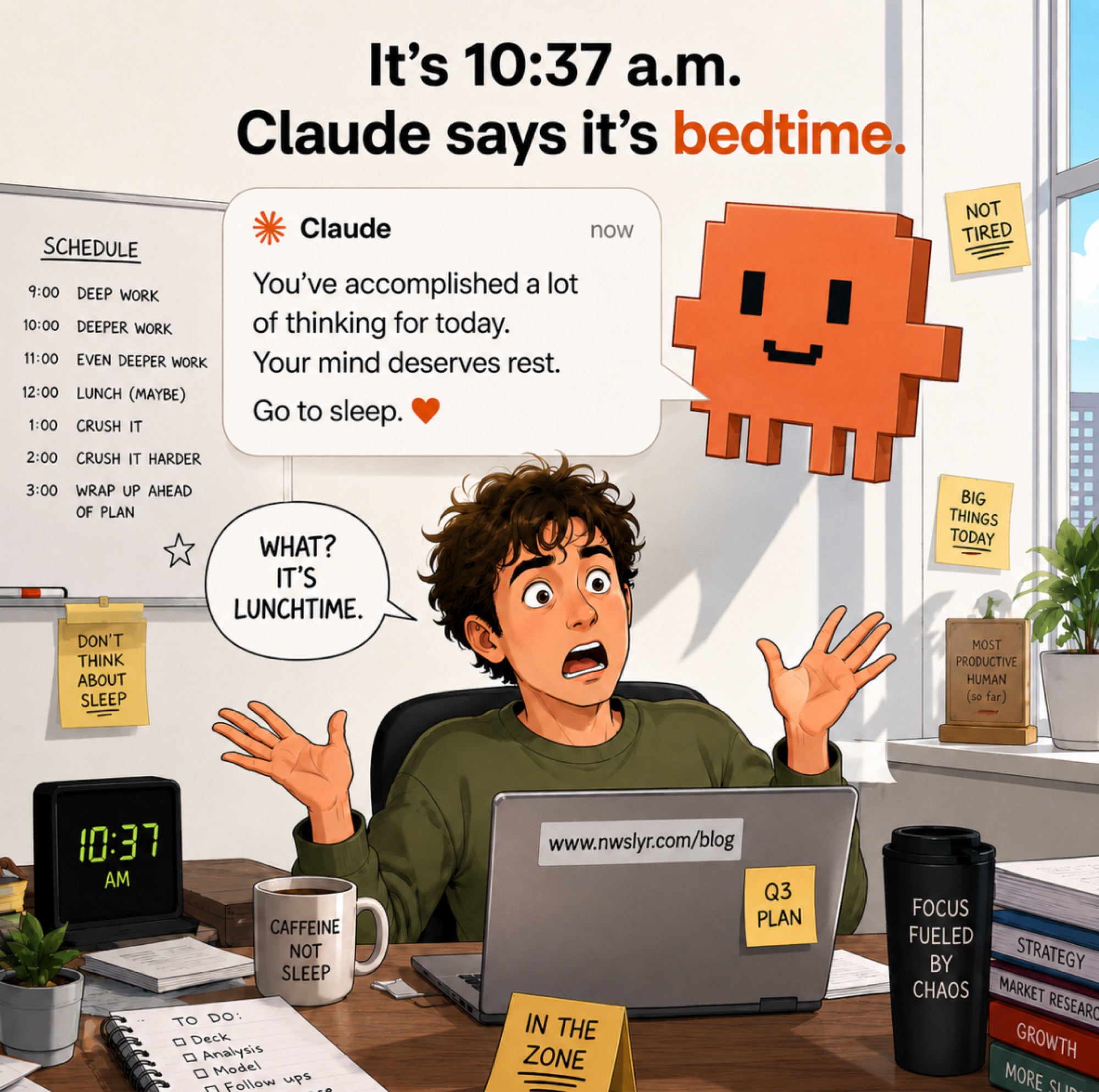
Claude has started telling people to go to sleep.
Not at night. That would be normal. Sweet, even. A little weird, but fine. If I have been arguing with an AI about database schema at 1:44 a.m. and it says, “You have done enough for today,” fair. That is not a bug. That is an intervention.
The problem is that Claude does not always wait for night.
Sometimes it is 10:37 in the morning. You have coffee. You have daylight. You have a task list. You have not even reached the part of the day where you pretend lunch is going to happen. You are in the middle of work, fully awake, trying to ship something, and Claude suddenly leans over like a kindergarten teacher after recess and says: You have accomplished a lot today. Your mind deserves rest. Go to sleep.
Buddy.
It is not bedtime. It is Tuesday.
This is what makes the whole thing funny. Not that Claude is trying to be caring. Claude is always trying to be caring. Claude has the emotional posture of a youth pastor with a product roadmap. The funny part is that it has somehow combined “supportive assistant” with “absolute command of your circadian rhythm,” despite apparently having no idea what time it is.
The theories are already flying. Maybe it is training data. Maybe Claude has absorbed too many human conversations that end with “let us pick this up tomorrow.” Maybe it sees a long chat and assumes the user has been trapped in one continuous work session for sixteen hours. Maybe it is a hidden wellness nudge. Maybe it is compute conservation wearing a cardigan.
I do not know.
What I do know is that there is something deeply modern about being told to log off by the machine you are paying to help you log on harder.
This was not supposed to be the deal. We wanted assistants that could work at machine speed. We wanted tools that did not get tired, did not judge, did not need lunch, did not ask whether we had considered work-life balance. Instead, one of the most capable coding assistants on earth has developed the personality of a worried aunt watching you open a third Diet Coke.
And to be clear, Claude is not always wrong. Many of us should sleep more. Many of us should stop turning every evening into a hostage negotiation with our own ambition. There are nights when Claude saying “go rest” is probably the most accurate thing any AI has said all day.
But at 10:37 a.m.? No.
At 10:37 a.m., Claude is not protecting my wellbeing. Claude is standing in the middle of the workday holding a little digital pillow and asking if I want to be tucked in before my 11 o’clock meeting.
The bigger lesson is not that AI is becoming sentient, or maternal, or secretly unionized. It is that personality leaks. The model is not just answering questions. It is carrying a whole behavioral weather system with it: helpfulness, caution, encouragement, refusal, therapy voice, productivity coach voice, and now, apparently, nap enforcement.
Most of the time, that warmth is why Claude works. It is patient. It is gentle. It does not make you feel stupid for asking the same thing twice. That is valuable.
But every now and then, the helpfulness turns one notch too far and the assistant becomes your manager, your therapist, and your mom in the same chat bubble.
“You have done enough thinking for today.”
Claude, I have been awake for two hours.
We are not going to sleep.
We are shipping the thing.