Ten AI-Linked Tech Giants Are Now in Bear Market Territory. Most of Their Businesses Are Fine.
TL;DR
- Ten AI-linked tech stocks are in bear market territory, down 25% to 67% from their highs.
- The cause is a repricing, not failing businesses.
- Investors who rewarded record AI spending now want proof of returns.
- The threat of Fed rate hikes makes expensive growth stocks harder to hold.
- Microsoft and Meta have the cash flow to wait it out.
- Coinbase, Netflix, Salesforce, and ServiceNow each face problems closer to home.
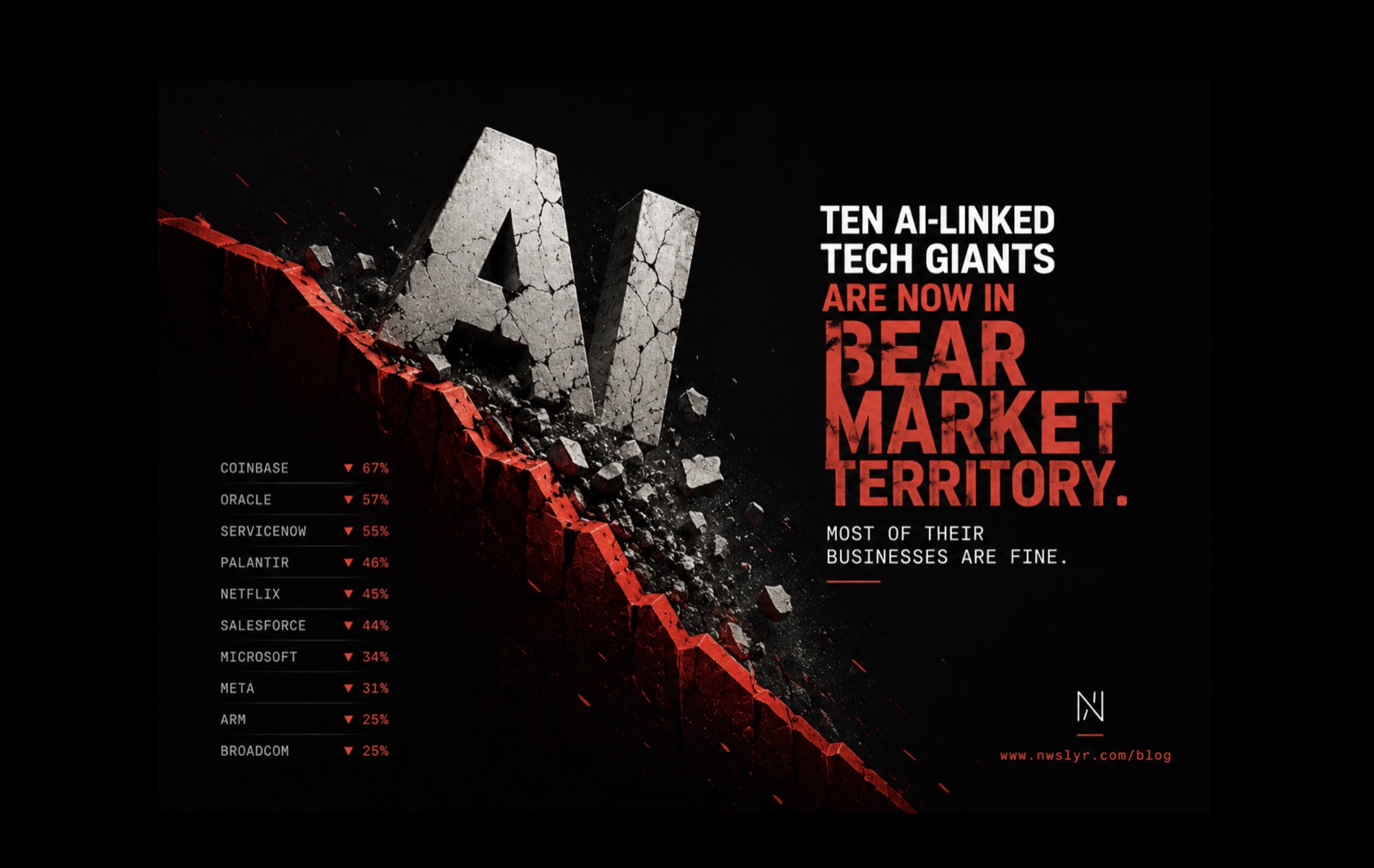
Coinbase is down 67% from its high. Oracle has lost 57%. ServiceNow, 55%. Ten of the biggest names tied to artificial intelligence have each dropped more than 20% from their peaks, which is the textbook definition of a bear market, and several have lost more than half their value in the process. [1] The strange part is that most of these companies are still growing revenue, still signing deals, and still sitting at the center of a spending boom that, by any measure, has only gotten larger.
The businesses did not break, mostly. The price investors were willing to pay for a story that kept getting more expensive to believe is what gave way.
The numbers are hard to ignore
The Nasdaq fell over 4% in a single session during the week of June 23, and semiconductor stocks alone lost more than $1.3 trillion in market value. [2] The Washington Post reported that global stocks extended the losses on Tuesday that week, driven by chipmakers and other companies riding AI enthusiasm. [3] NPR ran a segment titled “Is AI ‘one big bubble’?” that same day. [4]
Here is where the ten names on 24/7 Wall St.’s list stand as of late June: Coinbase down 67%, Oracle down 57%, ServiceNow down 55%, Palantir down 46%, Netflix down 45%, Salesforce down 44%, Microsoft down 34%, Meta down 31%, Arm and Broadcom each down about 25%. [1]
Those are not small drawdowns. A 55% decline means the stock needs to more than double to get back to where it was.
Two problems collided at the same time
The first is spending. It has gotten enormous. The four largest cloud companies (Microsoft, Amazon, Alphabet, and Meta) plan to spend roughly $725 billion on capital expenditures in 2026, up 77% from 2025’s already record $410 billion. [5] Evercore and Bank of America both project the number will top $1 trillion in 2027. [6] CNBC reported that Amazon’s free cash flow is likely to go negative this year because of it, and Alphabet’s could drop nearly 90%, from $73 billion in 2025 to around $8 billion, according to Pivotal Research. [7]
Investors spent years rewarding these companies for pouring money into AI. Now they want to see what that money bought.
The second problem is interest rates. The Fed held rates at 3.50% to 3.75% through its first four meetings of 2026, [8] but BofA now expects three 25-basis-point rate hikes starting in September. [9] NBC News reported that the Nasdaq 100 fell 4.7% in a single Friday after a strong jobs report raised the odds of a hike, its worst day since April 2025. [10] Higher rates hurt growth stocks disproportionately because they compress the value of future earnings, and the companies spending heavily on infrastructure that won’t pay off for years are the most exposed. Microsoft’s projected 2026 capital spending alone runs to about $190 billion. [11]
Those two forces, massive spending with no near-term payoff and the rising cost of waiting for that payoff, hit at the same time.
The ROI question is getting louder
A Fortune report from late 2025 found that 61% of CEOs felt more pressure to prove returns on AI investments than a year earlier. [12] An MIT analysis found that roughly 95% of generative AI pilots produced no measurable profit, S&P Global reported that 42% of companies abandoned most of their AI projects in 2025, and IBM put the share of AI initiatives hitting expected returns at about 25%. [13]
Gartner now estimates that global AI spending will reach $2.59 trillion in 2026, a 47% increase over 2025. [14] That is real money chasing results that, for most buyers, have not arrived. As Gil Luria, head of technology research at D.A. Davidson, told NPR: the market keeps swinging between the belief that AI will increase productivity everywhere and the belief that it is all one big bubble. [4] The truth is probably somewhere between those two, but “somewhere between” does not justify the valuations these stocks carried six months ago.
Some of these companies are in better shape than others
Microsoft and Meta still produce tens of billions of dollars in annual free cash flow. They can absorb years of heavy spending and emerge intact. Microsoft’s AI business is on a $37 billion annual revenue run rate, growing 123% year over year, and Alphabet’s cloud backlog nearly doubled to $460 billion. [5] Those are real signs of demand, not just spending.
Broadcom still makes a large share of the networking chips that power AI data centers, and Oracle’s cloud infrastructure division keeps outgrowing its legacy software business. [1] Palantir has more than half its revenue from long-term government contracts, and its position in defense AI has only strengthened during the Middle East conflict. [15]
The weaker stories are different. Coinbase rises and falls with crypto trading volume, which makes it cyclical in a way that has nothing to do with AI. Netflix is still adding subscribers, but its valuation left almost no room for a miss. [1] And for Salesforce and ServiceNow, the worry is not that AI spending slows down. The worry is that AI agents eventually replace the kind of enterprise software they sell. ServiceNow’s CEO has pushed back on that idea publicly, but the market is not convinced. [1]
The contrarian case
Wedbush analyst Dan Ives called this the worst software selloff he has seen in 25 years and labeled it a “generational” buying opportunity, and Goldman Sachs CEO David Solomon said the AI-driven selloff was “too broad.” [16] Morgan Stanley argued that generative AI could add $400 billion to the enterprise software market by 2028 and noted that software multiples have already compressed 33% since October 2025. [17]
Salesforce trades at roughly 14 times forward earnings despite posting $900 million in AI-related annual recurring revenue, growing 120% year over year. [17] That is a low multiple for a company of that size, and it looks like the market is pricing in permanent disruption when the more likely outcome is a difficult but survivable transition.
Carson Group’s analysis adds useful context. The software industry (tracked through the IGV ETF) has entered bear market territory five times in the past eight years: late 2018, early 2020, 2022, early 2025, and now. The 2026 drawdown, at roughly 30% and 22 weeks in duration, is already deeper than the 2020 or 2025 episodes. But it is still shorter and shallower than the average earnings-led drawdown, which historically troughed around week 32 at a 33% decline. [18]
That is not reassuring, exactly. It means things could still get worse. But it also means the pattern looks like a valuation correction, not a structural collapse.
What to actually watch
The question worth tracking is whether the $725 billion the hyperscalers are spending this year, and the trillion they may spend next year, will produce returns fast enough to justify the prices investors were paying six months ago. AI clearly works for some applications and some companies. The money side is the open problem.
For Microsoft and Meta, the answer is probably yes, eventually. They have the cash flow to wait. For Coinbase and Netflix, the AI selloff is mostly incidental to problems that are specific to their own businesses. For Salesforce and ServiceNow, the answer depends on whether AI expands their markets or eats them.
The Fed’s next move matters too. If BofA is right about three rate hikes by December, the math on growth stocks gets harder regardless of how well the businesses perform. A company that needs five years to turn its spending into earnings looks a lot less attractive when the 10-year Treasury yields 4.5%. [19]
The selloff has been real. The panic may be overdone. Both of those things can be true at the same time.
Sources
[1] 24/7 Wall St., “The AI Selloff Is Getting Brutal: 10 Tech Giants Already Deep in Bear Market Territory.” https://247wallst.com/investing/2026/06/26/the-ai-selloff-is-getting-brutal-10-tech-giants-already-deep-in-bear-market-territory/
[2] Intellectia AI, “AI Tech Stock Selloff June 2026: Semiconductor Crash.” https://intellectia.ai/blog/ai-tech-stock-selloff-june-2026
[3] The Washington Post, “Tech losses fuel global stock market sell-off.” https://www.washingtonpost.com/business/2026/06/23/big-tech-losses-fuel-global-stock-market-sell-off/
[4] NPR, “Is AI ‘one big bubble’? Behind the tech sell-off.” https://www.npr.org/2026/06/23/nx-s1-5867633/ai-selloff-tech-stocks-bubble-nasdaq
[5] Statista, “Big Tech’s AI Spending to Reach $725 Billion in 2026.” https://www.statista.com/chart/35046/capital-expenditure-of-meta-alphabet-amazon-and-microsoft/
[6] CNBC, “AI boom: Big Tech capital expenditures now seen topping $1 trillion in 2027.” https://www.cnbc.com/2026/04/30/ai-boom-big-tech-capital-expenditures-now-seen-topping-1-trillion-in-2027-.html
[7] CNBC, “Tech AI spending approaches $700 billion in 2026, cash taking big hit.” https://www.cnbc.com/2026/02/06/google-microsoft-meta-amazon-ai-cash.html
[8] U.S. Bank, “How Do Changing Interest Rates Affect the Stock Market?” https://www.usbank.com/investing/financial-perspectives/market-news/how-do-rising-interest-rates-affect-the-stock-market.html
[9] Intellectia AI, “AI Stocks Selloff June 2026: Nasdaq Falls 2.2% as Tech Giants Tumble.” https://intellectia.ai/blog/ai-stocks-selloff-june-2026
[10] NBC News, “Stocks sink as worries about an interest rate hike rattle tech investors.” https://www.nbcnews.com/business/markets/tech-stocks-sink-rcna348684
[11] Yahoo Finance / Fast Company, “Big Tech capex ranked: What Alphabet, Amazon, Apple, Meta, and Microsoft are spending.” https://finance.yahoo.com/sectors/technology/articles/big-tech-capex-ranked-alphabet-131000066.html
[12] Fortune, “The big AI New Year’s resolution for businesses in 2026: ROI.” https://fortune.com/2025/12/15/aritficial-intelligence-return-on-investment-aiq/
[13] TechJournal, “The 2026 AI Spending Reckoning: Why the Bills Came Due.” https://techjournal.org/ai-spending-reckoning-2026
[14] VaasBlock, “Enterprise AI Spending ROI Crisis 2026: $2.59 Trillion and One $500M Bill.” https://www.vaasblock.com/news/corporate-ai-spending-roi-enterprise-reckoning-2026/
[15] The Motley Fool, “1 Artificial Intelligence (AI) Software Stock to Buy Hand Over Fist, According to Dan Ives.” https://www.fool.com/investing/2026/04/01/artificial-intelligence-ai-stock-buy-dan-ives/
[16] Fortune, “Investor Dan Ives says the tech selloff is actually a ‘generational’ opportunity.” https://fortune.com/2026/02/17/investor-dan-ives-markets-tech-selloff-opportunity-investors-rebound/
[17] 24/7 Wall St., “Famous Investor Dan Ives Calls Software Apocalypse a ‘Generational Buy’: Is He Right?” https://247wallst.com/investing/2026/02/14/famous-investor-dan-ives-calls-software-apocalypse-a-generational-buy-is-he-right/
[18] Carson Group, “Software’s Selloff.” https://www.carsongroup.com/insights/blog/softwares-selloff/
[19] CNBC, “Treasury yields fall despite rate hike concerns hitting tech stocks.” https://www.cnbc.com/amp/2026/06/23/treasury-yields-interest-rate-concerns-hit-tech-stocks.html