AI Jargon Dictionary: Plain English Definitions for Terms Everyone Keeps Using
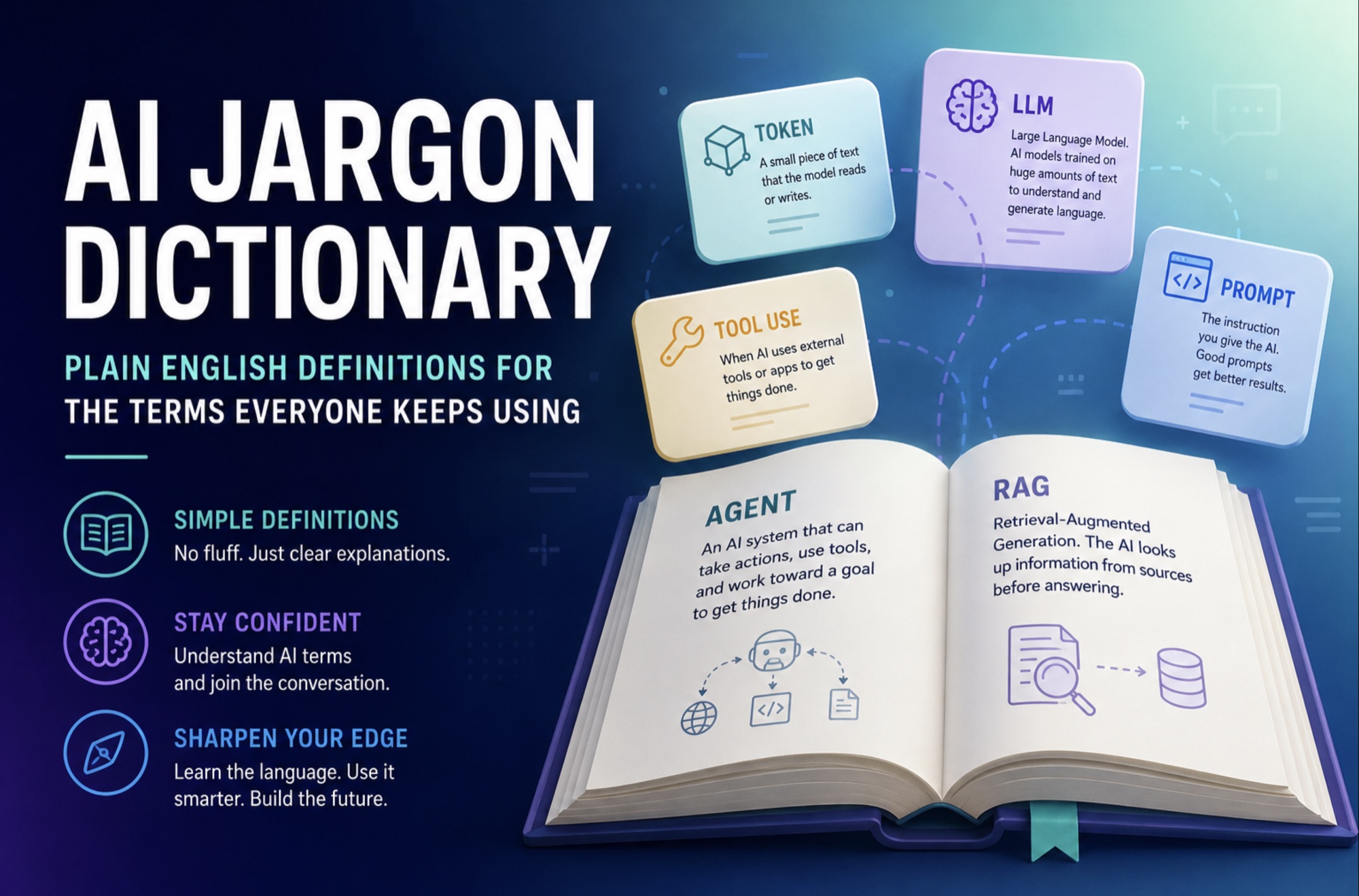
AI conversations get buried in buzzwords fast. Here is a simple dictionary for the terms you keep seeing, without the fog machine.
The Basics
AI
Artificial intelligence. A broad term for software that can do tasks we usually associate with human thinking, like writing, summarizing, recognizing patterns, answering questions, coding, or making predictions.
Generative AI
AI that creates new content. That can mean text, images, video, music, code, slides, reports, synthetic data, or designs.
Model
The actual AI system that produces the answer. ChatGPT, Claude, Gemini, and other tools are powered by models.
Large Language Model
An AI model trained on huge amounts of text so it can understand and generate language. It does not “know” things like a person does. It predicts and produces responses based on patterns.
LLM
Short for large language model. This is the abbreviation people use when they want to sound busy.
Frontier Model
A top-tier AI model near the current edge of capability. People usually use this phrase for the newest, strongest models from companies like OpenAI, Anthropic, Google, xAI, Meta, and others.
Foundation Model
A large general-purpose model that can be adapted for many different jobs. It is called “foundation” because other products and systems can be built on top of it.
Multimodal AI
AI that can work with more than one kind of input or output. For example: text, images, audio, video, code, files, screenshots, or spreadsheets.
Open-Source Model
A model whose code, weights, or related materials are available for others to use, inspect, or modify. The details matter because “open-source” can mean very different things depending on the license and what is actually released.
Model Weights
The internal numbers a model uses to generate outputs. If the model is the brain, the weights are the learned settings inside it.
Parameters
The internal values a model learns during training. More parameters can mean more capacity, but bigger is not automatically better.
Prompts and Context
Prompt
The instruction you give an AI system. A prompt can be a question, a command, a piece of text to rewrite, or a detailed set of requirements.
Prompt Engineering
The practice of writing better instructions so an AI gives better answers. In plain English, it means learning how to ask clearly.
System Prompt
The top-level instruction that tells the AI how it should behave. It can define tone, rules, formatting, safety boundaries, or product behavior.
Developer Message
An instruction layer used in some AI systems that sits above the user’s request. It tells the model how to behave inside a product or workflow.
Context Window
The amount of information an AI model can consider at once. A bigger context window means the model can handle more text, documents, code, or conversation history before it starts losing track.
Context Engineering
Designing what information gets placed in front of the model. Prompt engineering is about how you ask. Context engineering is about what the model gets to see before it answers.
Token
A chunk of text the model reads or writes. A token can be a word, part of a word, punctuation, or spacing. AI companies often price usage by tokens.
Input Tokens
The tokens you send into the model. This includes your prompt, attached text, conversation history, and tool results.
Output Tokens
The tokens the model generates back to you.
Cached Tokens
Input tokens the system has seen before and can reuse more cheaply or efficiently. This matters for cost when the same documents, prompts, or codebases are reused.
Training and Running AI
Training Data
The material used to teach an AI model patterns. This can include books, websites, code, articles, licensed data, human-generated examples, synthetic data, and other sources depending on the model.
Training
The process of building a model by exposing it to large amounts of data and adjusting its internal settings.
Fine-Tuning
Additional training that adapts a model for a specific style, task, company, or use case. Think of it as taking a general model and giving it specialized practice.
Post-Training
The work done after the main training run to make a model more useful, safer, more obedient to instructions, or better at specific tasks.
Reinforcement Learning
A training method where a model is improved using feedback. In simple terms, it learns which kinds of answers are preferred.
RLHF
Short for reinforcement learning from human feedback. Humans compare or rate outputs, and the model is trained to produce responses people prefer.
Synthetic Data
Data created artificially rather than collected from the real world. It can be used to train or test AI systems, but quality matters.
Distillation
Training a smaller model to imitate a larger model. The goal is usually to make AI cheaper, faster, or easier to run.
Quantization
A technique for making models smaller or more efficient by reducing numerical precision. In plain English, it helps run AI with less computing power, sometimes with a tradeoff in quality.
Inference
The moment when an AI model generates an answer. Training is how the model learns. Inference is when you use it.
Test-Time Compute
Extra computing power used while the model is answering. Some models spend more time and computation on harder problems instead of giving the fastest possible response.
Reasoning Effort
A setting that controls how much work the model puts into a task. Low effort is faster. Higher effort can be better for complex work, but usually costs more time or tokens.
Latency
How long it takes for the AI to respond. Lower latency means faster answers.
Throughput
How much work an AI system can handle over time. For businesses, this matters when many users or tasks are running at once.
Compute
The processing power needed to train or run AI models. When people say AI needs more compute, they mean more chips, servers, electricity, and money.
GPU
A chip originally designed for graphics that is also very good at the math used in AI. GPUs are one reason modern AI can run at scale.
Accuracy, Trust, and Failure Modes
Hallucination
When an AI gives an answer that sounds confident but is wrong, made up, or unsupported. Hallucination is one of the biggest reasons AI output still needs review.
Grounding
Connecting an AI answer to reliable source material. A grounded answer is based on something specific, like a document, database, search result, or verified record.
RAG
Short for retrieval-augmented generation. It means the AI looks up information from a source, like documents or a database, before answering. This helps reduce guessing.
Embeddings
A way of turning text, images, or other information into numbers so a computer can compare meaning. Embeddings help AI search for things that are conceptually similar, not just exact keyword matches.
Vector Database
A database built to store and search embeddings. It helps AI systems find relevant information quickly.
Benchmark
A test used to compare AI models. Benchmarks can be useful, but they do not always reflect real-world performance.
Eval
Short for evaluation. An eval is a test or review process used to measure how well an AI system performs on a task.
SWE-bench
A benchmark used to test how well AI systems handle real software engineering problems. It is often mentioned when companies talk about coding models.
Model Drift
When an AI system becomes less accurate or useful over time because the real world changes, the data changes, or user behavior changes.
Explainability
The ability to understand why an AI system produced a certain result. This is easy to ask for and hard to guarantee.
Black Box
A system where you can see the input and output, but not easily understand what happened inside. Many AI models are described this way.
Agents and Workflows
Agent
An AI system that can take steps toward a goal, often by using tools, searching information, writing code, reading files, or completing a workflow. The word gets overused. Sometimes “agent” just means “chatbot with extra steps.”
Agentic AI
AI that does more than answer one prompt. It plans, uses tools, takes actions, checks progress, and continues working toward a goal.
Agentic Workflow
A workflow where AI is not just generating text but moving through steps: gather information, make a plan, use tools, revise, verify, and report back.
Long-Horizon Task
A task that takes many steps over a longer period of work. Examples include refactoring a codebase, researching a market, building a report, migrating software, or preparing a complex analysis.
Tool Use
When an AI model calls another system to get something done. For example, checking a calendar, searching files, running code, browsing the web, querying a database, or creating a spreadsheet.
Tool Calling
The technical version of tool use. The model decides that it needs a tool, sends a structured request, receives the result, and continues.
Function Calling
A structured way for an AI model to call a specific software function. This is common in developer products.
Agent Loop
The cycle an agent follows: read the request, think through the next step, call a tool if needed, observe the result, update the plan, and continue until the task is done.
Harness
The software around the model that manages tools, files, permissions, prompts, memory, and execution. The model is not the whole agent. The harness is what lets the model do useful work safely.
Subagent
A smaller agent assigned to a piece of a larger task. For example, one subagent might inspect tests, another might update documentation, and another might search for bugs.
Multi-Agent Workflow
A setup where multiple agents work in parallel or coordinate on different parts of a task. Useful in theory, messy in practice if nobody controls quality.
Human in the Loop
A setup where a person reviews or approves AI output before it is used. This is important in high-stakes areas like law, medicine, finance, hiring, security, and public communications.
Approval Step
A checkpoint where the AI must ask before taking an action. For example, editing files, sending an email, deleting records, or running code.
Guardrails
Rules or systems designed to keep AI behavior within certain boundaries. Guardrails can help prevent unsafe, irrelevant, private, or low-quality outputs.
Alignment
The effort to make AI systems behave in ways that match human goals, instructions, and safety expectations. It is a serious topic, although it is often used vaguely.
Product-Specific Frontier AI Terms
Codex
OpenAI’s coding agent. In current usage, Codex refers to a family of software-engineering tools that can help write code, review code, fix bugs, understand codebases, run tests, and prepare changes for human review.1
Codex CLI
A local coding agent from OpenAI that runs on your computer. It can inspect files, edit code, run commands, and work inside a development environment.2
Codex Cloud
A cloud-based Codex environment where coding tasks can run remotely instead of only on your local machine.2
Codex App
OpenAI’s app for managing coding agents. Think of it as a command center for assigning software tasks, tracking progress, and reviewing changes.1
Codex Worktree
An isolated copy of a codebase where an agent can make changes without disturbing the main version. Worktrees let multiple coding tasks happen in parallel.1
Agentic Coding
Software development where you delegate a coding task to an AI agent instead of only asking for suggestions. The agent may inspect the codebase, make edits, run tests, and prepare a pull request.
Coding Agent
An AI agent designed specifically for software work. It can usually read code, write code, run tests, inspect errors, and modify files.
Claude Code
Anthropic’s coding agent product. It lets Claude work inside software projects, inspect code, make changes, run commands, and help with engineering tasks.3
Claude Code on the Web
A cloud version of Claude Code that lets users delegate coding tasks through a browser-based environment.
Dynamic Workflows
Anthropic’s term for a Claude Code feature that lets Claude tackle very large tasks by planning the work, running many parallel agents, checking the outputs, and reporting back. Plain English: Claude can split a giant coding job into many smaller jobs and coordinate them.4
Claude Agent Skills
Reusable instruction and resource packages that teach Claude how to do a specific kind of task. A skill can include workflows, context, best practices, templates, or files that help Claude repeat specialized work.5
Skill
A reusable capability package for an AI agent. Instead of explaining the same workflow every time, a skill gives the agent a prepared way to do the job.
Custom Command
A saved instruction or shortcut that triggers a specific workflow. Useful when you repeat the same kind of task often.
ChatGPT Agent
OpenAI’s agentic ChatGPT experience for tasks that require research, tool use, and action. It is meant for more than a single answer.
Deep Research
An AI research mode that performs multi-step research across sources before producing a report. It is useful for complex questions, but the result still needs review.
Operator
OpenAI’s earlier agent concept for using a browser or interface to take actions. The broader idea is AI that does things, not just talks about them.
Computer Use
AI using a computer interface, browser, app, or operating system to complete tasks. This can include clicking, typing, navigating, reading screens, and taking actions.
Gemini Spark
Google’s term for a personal AI agent experience connected to goals and apps. In plain English, it is Google describing Gemini as more of a planning-and-action assistant, not just a chatbot.6
Neural Expressive
Google’s design language for Gemini. This is not a model capability. It is a product design term for how Gemini looks, feels, and responds visually.
Connectors, Apps, and External Tools
API
A way for software systems to talk to each other. An AI API lets developers send prompts to a model and receive outputs inside their own app.
API Call
One request sent to an API. For AI, this usually means sending input to a model and getting a response back.
Rate Limit
A restriction on how many requests you can make in a certain period of time. Rate limits help companies control demand and prevent abuse.
Connector
A bridge between an AI system and another app or data source. For example, a connector might let AI search your files, update a CRM, create a task, or read a database.
MCP
Short for Model Context Protocol. It is an open standard for connecting AI systems to tools, apps, and data sources. In plain English, MCP is trying to become the USB-C port for AI tools.7
MCP Server
The system that exposes a tool or data source to an AI assistant. For example, a company might build an MCP server for its CRM, file system, database, or internal software.8
MCP Client
The AI-side software that connects to MCP servers. It requests information or actions from the external tool.
MCP Connector
A connector built using the Model Context Protocol. It lets an AI assistant use approved tools or retrieve approved information.
Read/Write Connector
A connector that can not only read information but also take action. For example, reading a project board is “read.” Creating a task or updating a customer record is “write.”
Tool Permission
A rule that controls what an AI tool is allowed to do. Good AI systems should not have unlimited access to everything by default.
Sandbox
A restricted environment where an AI agent can work without touching everything else. Sandboxes are used to limit damage if the agent makes a mistake.
Cloud Environment
A remote computing environment where an agent can run tasks, inspect files, install packages, or test code.
Self-Hosted Sandbox
A sandbox run inside a company’s own infrastructure instead of fully inside the AI vendor’s cloud.
Output Quality and Style
AI Slop
Low-quality AI-generated content that feels generic, careless, repetitive, or mass-produced. It is the internet equivalent of filler.
Overfitting to the Prompt
When the AI follows the wording too literally and misses the actual intent.
Mode Collapse
When AI outputs start sounding the same: same rhythm, same phrases, same structure, same dead corporate polish.
AI Cadence
The recognizable rhythm of AI writing. It often sounds overly balanced, overly smooth, and allergic to personality.
Few-Shot Learning
Giving the AI a few examples in the prompt so it understands the pattern you want. For example, showing three rewritten headlines before asking it to write a fourth.
Zero-Shot Learning
Asking the AI to do a task without giving it examples first.
Chain of Thought
A term for reasoning steps a model may use internally or display externally. In practice, you usually just need the model to give a clear explanation, not a theatrical transcript of its thinking.
Temperature
A setting that affects how predictable or creative the model’s output is. Lower temperature usually means more consistent answers. Higher temperature usually means more variety.
Structured Output
An answer formatted in a predictable structure, like JSON, a table, a schema, or a specific template. This matters when AI output needs to feed another system.
Business AI Terms
Workflow
A sequence of steps needed to complete a task. AI workflows combine models, tools, data, and rules to get work done more reliably.
Automation
Software doing a task without a person manually doing every step. AI automation usually means the system can handle some judgment or language along the way.
Copilot
An AI assistant that helps a person do work instead of doing the whole job alone. A coding assistant, writing assistant, or support assistant can all be called copilots.
Chatbot
A tool that responds through conversation. Some chatbots are basic rule-based systems. Modern AI chatbots use language models.
Enterprise AI
AI products built for businesses, usually with stronger controls around privacy, security, admin settings, compliance, and integration with company systems.
AI Native
A product or company designed around AI from the beginning. Sometimes meaningful. Often marketing.
AI Wrapper
A product that mainly puts a user interface around someone else’s AI model. Not automatically bad, but not automatically defensible either.
Orchestration
The coordination layer that decides which model, tool, data source, or workflow should be used. In plain English, it is the traffic controller.
Governance
The policies, controls, audits, and approvals that determine how AI is used inside an organization.
Auditability
The ability to see what the AI did, what data it used, what tools it called, and who approved the action.
Data Privacy
The question of what happens to the information users give an AI system. This includes whether data is stored, used for training, shared, deleted, or protected.
Memory
A feature that lets an AI system remember useful information across conversations. Memory can be helpful, but it also raises privacy and control questions.
Personalization
When an AI system adapts to a specific user’s preferences, style, history, or needs.
The Bottom Line
Most AI jargon is just normal software language wearing a more expensive jacket. The useful question is not whether something sounds advanced. The useful question is what it does, how reliable it is, what data it uses, what actions it can take, and whether a human still needs to check the work.
Source Notes
Footnotes
-
OpenAI, “Codex | AI Coding Partner from OpenAI,” https://openai.com/codex/ ↩ ↩2 ↩3
-
OpenAI Developers, “Unrolling the Codex agent loop,” https://openai.com/index/unrolling-the-codex-agent-loop/ ↩ ↩2
-
Anthropic, “Best practices for Claude Code,” https://www.anthropic.com/engineering/claude-code-best-practices ↩
-
Anthropic, “Introducing Claude Opus 4.8,” https://www.anthropic.com/news/claude-opus-4-8 ↩
-
Anthropic Docs, “Extend Claude with skills,” https://docs.anthropic.com/en/docs/claude-code/skills ↩
-
Google, “The Gemini app becomes more agentic, delivering new personal AI experiences,” https://blog.google/innovation-and-ai/products/gemini-app/next-evolution-gemini-app/ ↩
-
Anthropic, “Introducing the Model Context Protocol,” https://www.anthropic.com/news/model-context-protocol ↩
-
Anthropic Docs, “Connect Claude Code to tools via MCP,” https://docs.anthropic.com/en/docs/claude-code/mcp ↩