AI Agents Are Useful. They Are Still Not Employees.
AI agents are moving into the ordinary machinery of work. Microsoft pitches autonomous agents for sales, service, finance, and supply chain teams, and describes Agent 365 as a “control plane” for observing, securing, and governing agents across an organization.[1][2] Atlassian put agents inside Jira so companies can assign and manage agent work from the same dashboard they use for people.[3] BNY runs more than 100 “digital employees,” each with its own persona, credentials, and supervisor.[4]
And the agents are useful. They move information between systems, summarize work, draft responses, monitor tasks, flag exceptions, and take action inside bounded workflows.[1][2][4][5] BNY’s Eliza platform alone supports more than 125 live use cases, with 20,000 employees actively building agents.[5]
The trouble starts with the word “employee.”
A new Harvard Business Review article, based on a working paper by Emma Wiles, Megan Hsu, Julie Bedard, and Matthew Kropp, looks at what happens when organizations describe AI agents as employees rather than tools.[6][7] In their survey of 1,261 HR and finance managers, 31% said their organization frames AI as a teammate or employee, and 23% said their organization lists AI agents on org charts or workflow charts.[7] This is no longer marketing copy. In nearly a quarter of the workplaces surveyed, the metaphor is written into the management structure.[4][7][8]
The experiment was simple. Every manager reviewed the same documents with the same built-in errors. The researchers changed one thing: how the source of the work was described. An AI tool, an AI employee (it even had a name, ALEX-3), or a human employee.[7] Across the full sample, the framing had no statistically significant average effect on review performance or oversight.[7] The result that matters showed up in a specific group: managers whose organizations had already put AI agents on their org charts.[7]
For them, the label changed behavior. When identical work was framed as coming from an AI employee instead of an AI tool, review performance fell by 16% and managers caught 18% fewer errors. Requests for additional review rose by 22 percentage points. And accountability moved: managers assigned about 9 percentage points less responsibility to themselves and about 8 points more to the AI system.[7][9]
Boston University’s summary is blunt: anthropomorphizing AI systems reduced personal accountability, increased unnecessary escalation and review cycles, lowered quality control, heightened employee uncertainty, and did not meaningfully increase adoption.[10] BCG reads it the same way: as AI scales, workflows should be redesigned to pair AI output with human judgment, not to shift responsibility onto the system.[9]
Here is the problem with the word. It does more than make software sound friendly: it changes who people believe is responsible for the work.
A human employee can be trained, warned, promoted, disciplined, and fired. Responsibility moves through those mechanisms, inside a social and legal structure everyone understands. An AI agent can be permissioned, monitored, logged, updated, restricted, or shut off.[2][7][11] The working paper makes the distinction directly: an AI system may make mistakes, but it cannot shirk, respond to incentives, or be disciplined, so responsibility cannot be transferred to it the way it transfers to a person.[7] The more access an agent has, the more that difference matters.
The gap between the label and the controls shows up in the marketing itself. The Verge described Microsoft Agent 365 as a platform that lets businesses manage agents “like they do people,” while the actual product features read like enterprise controls: dashboards, telemetry, alerts, identity registration, permission limits, security monitoring, data governance.[8][2] TechCrunch reported that Jira now lets users assign and manage AI-agent work from the same dashboard used for human employees.[3] Axios reported that BNY’s digital employees have performance reviews, human managers, email addresses, and logins.[11] Bloomberg profiled Junior, an AI employee from Kuse AI that sends early-morning Slack reminders about missed sales follow-ups.[12] WIRED has covered AI employees and AI executives as a cultural story as much as an enterprise software one.[13]
The metaphor sells for a reason. Work software is already organized around people: teams, dashboards, assignments, deadlines, reviews, escalation. Dropping agents into that frame makes them easy to slot into existing workflows[3][8][11] and just as easy to misunderstand.[7][10]
The better model is pro-control rather than anti-agent, and Microsoft’s own product language points in that direction. Agent 365 offers an agent registry, usage insights, visual mapping of agent activity and connections, access control through Microsoft Entra, security posture through Microsoft Defender, and data governance through Microsoft Purview.[2] That is the right category. An agent is a system actor with permissions, not a junior colleague.
Gartner’s forecasts make the governance question harder to wave off. In August 2025, the firm predicted that 40% of enterprise applications would include task-specific AI agents by the end of 2026, up from less than 5% in 2025.[14] By May 2026, it was warning that 40% of enterprises will demote or decommission autonomous AI agents by 2027 because of governance gaps discovered only after production incidents, and that treating agent governance as binary, either locked down or fully trusted, fails in both directions.[15]
Policy is converging on the same distinction. NIST’s AI Risk Management Framework is organized around governing, mapping, measuring, and managing AI risks across the lifecycle of a system.[16] The EU AI Act’s human oversight article says high-risk AI systems must be designed so natural persons can effectively oversee them, with oversight proportionate to the system’s risk, autonomy, and context of use. The people doing that oversight should be able to understand the system’s limitations, monitor its operation, stay alert to automation bias, interpret its outputs, override or reverse them, and interrupt the system when needed.[17] That requirement applies to high-risk systems, so it should not be read as a rule for every office agent.[17] But the direction is consistent: the more autonomy a system gets, the more explicit the human oversight structure has to become.[15][16][17]
In practice, this means answering unglamorous questions. Who approves the email the agent drafted before it goes out? Who owns the accuracy of the CRM record it updated? When it routes an invoice, somebody still signs off before money moves, and when it escalates a coworker’s delay, somebody should review whether the escalation was fair. Those are management questions, and the agent cannot be the answer to any of them.
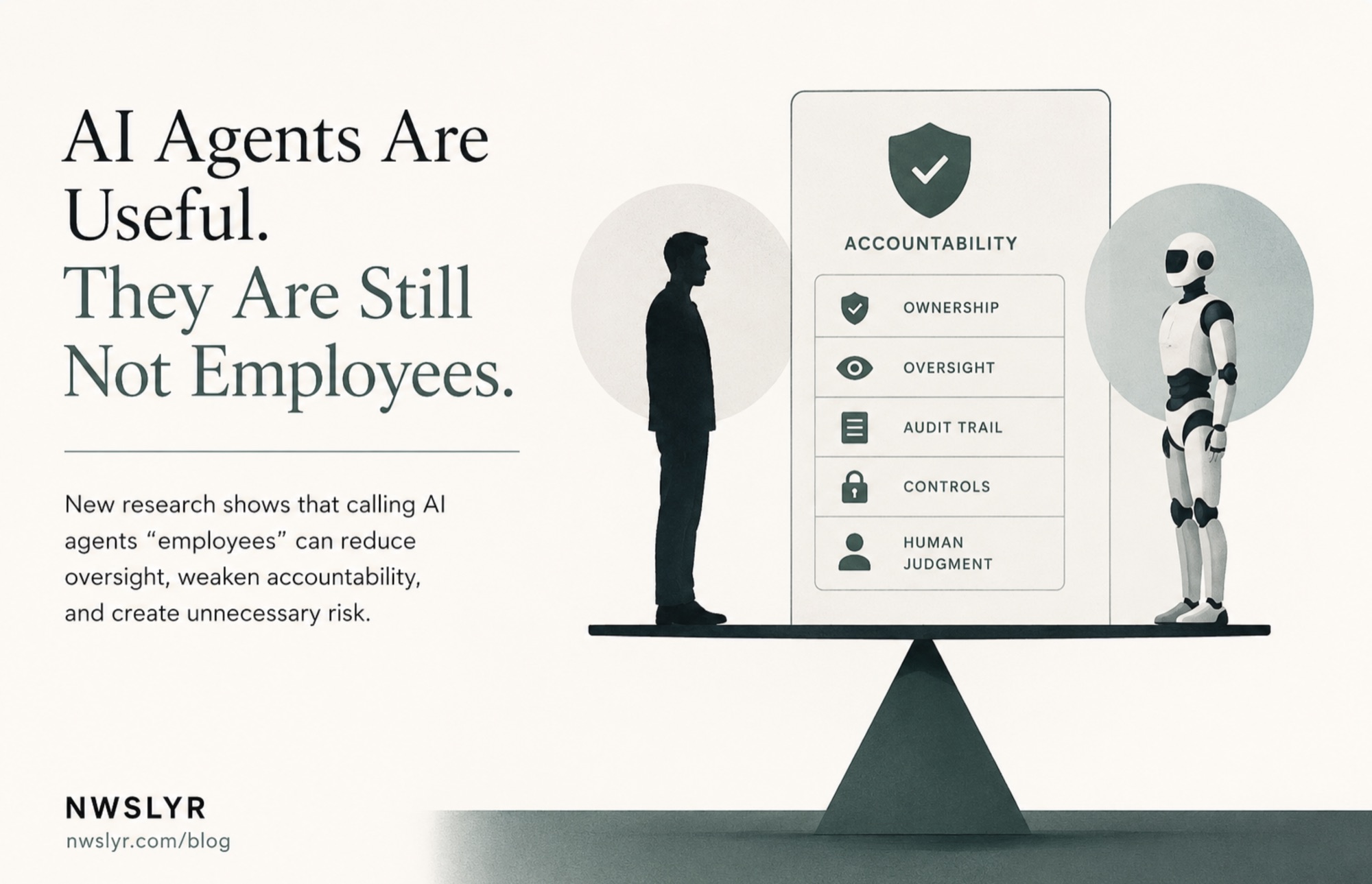
The safest language is usually the plainest. An agent is an agent. Give it an owner, a permission boundary, an audit trail, and a way to shut it off.[2][15][16][17]
None of this is an argument against using agents. The better they get at doing pieces of work, the more it matters that accountability stays with the people and institutions that decide where the agent is allowed to act.[7][15][16][17] An AI agent can hold a task. It cannot hold responsibility.
Sources
[1] Microsoft. “New autonomous agents scale your team like never before.” October 21, 2024. https://blogs.microsoft.com/blog/2024/10/21/new-autonomous-agents-scale-your-team-like-never-before/
[2] Microsoft. “Microsoft Agent 365: The Control Plane for Agents.” https://www.microsoft.com/en-us/microsoft-agent-365
[3] TechCrunch. “Jira’s latest update allows AI agents and humans to work side by side.” February 25, 2026. https://techcrunch.com/2026/02/25/jiras-latest-update-allows-ai-agents-and-humans-to-work-side-by-side/
[4] BNY. “AI In the Next Phase: Driving Adoption.” October 20, 2025. https://www.bny.com/corporate/global/en/insights/unlocking-potential-enterprise-ai-platform-bny.html
[5] OpenAI. “BNY builds ‘AI for everyone, everywhere’ with OpenAI.” December 12, 2025. https://openai.com/index/bny/
[6] Harvard Business Review. “Research: Why You Shouldn’t Treat AI Agents Like Employees.” May 6, 2026. https://hbr.org/2026/05/research-why-you-shouldnt-treat-ai-agents-like-employees
[7] Emma Wiles, Megan Hsu, Julie Bedard, and Matthew Kropp. “Putting AI on the Org Chart: Evidence on Delegation and Oversight.” Working paper, May 19, 2026 draft. https://emmawiles.github.io/storage/ai_employee.pdf
[8] The Verge. “Microsoft Agent 365 lets businesses manage AI agents like they do people.” https://www.theverge.com/news/822035/microsoft-agent-365-businesses-control-security
[9] Boston Consulting Group. “Why You Shouldn’t Treat AI Agents Like Employees.” May 6, 2026. https://www.bcg.com/news/6may2026-why-you-shouldnt-treat-ai-agents-employees
[10] Boston University Questrom School of Business. “Research: Why You Shouldn’t Treat AI Agents Like Employees.” May 6, 2026. https://insights.bu.edu/research-why-you-shouldnt-treat-ai-agents-like-employees/
[11] Axios. “This Wall Street bank has over 100 ‘digital employees.’” October 17, 2025. https://www.axios.com/2025/10/17/ai-wall-street-digital-workers
[12] Bloomberg Law. “Meet the New AI Coworker Who Won’t Stop Snitching to Your Boss.” April 2, 2026. https://news.bloomberglaw.com/capital-markets/meet-the-new-ai-coworker-who-wont-stop-snitching-to-your-boss
[13] WIRED. “All of My Employees Are AI Agents, and So Are My Executives.” November 12, 2025. https://www.wired.com/story/all-my-employees-are-ai-agents-so-are-my-executives/
[14] Gartner. “Gartner Predicts 40% of Enterprise Apps Will Feature Task-Specific AI Agents by 2026, Up from Less Than 5% in 2025.” August 26, 2025. https://www.gartner.com/en/newsroom/press-releases/2025-08-26-gartner-predicts-40-percent-of-enterprise-apps-will-feature-task-specific-ai-agents-by-2026-up-from-less-than-5-percent-in-2025
[15] Gartner. “Gartner Says Applying Uniform Governance Across AI Agents Will Lead to Enterprise AI Agent Failure.” May 26, 2026. https://www.gartner.com/en/newsroom/press-releases/2026-05-26-gartner-says-applying-uniform-governance-across-ai-agents-will-lead-to-enterprise-ai-agent-failure
[16] NIST AI Resource Center. “AI RMF Core.” https://airc.nist.gov/airmf-resources/airmf/5-sec-core/
[17] European Union. Regulation (EU) 2024/1689, Article 14, Human Oversight. https://eur-lex.europa.eu/eli/reg/2024/1689/oj/eng